The Father’s Will.

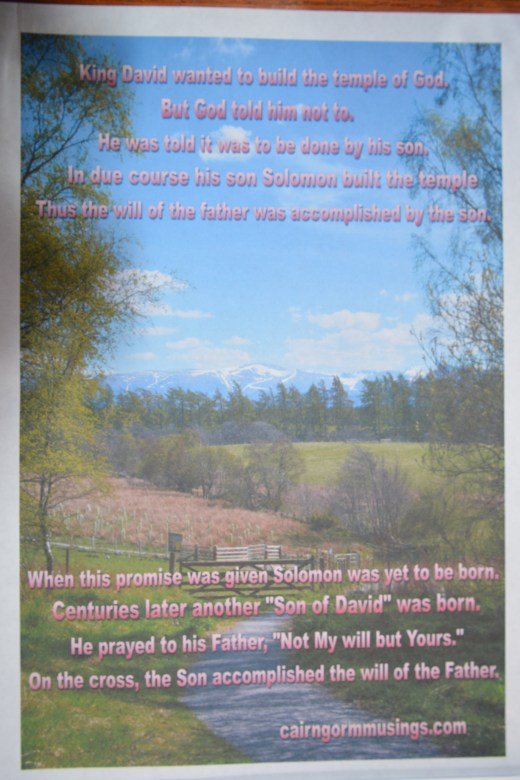
DSC_0637(Apologies due to technical difficulties I was unable to upload the document directly, and my scanner seemed to have stopped working as well, so I had to photo it instead and upload it that way.)  The basic thoughts that brought about the text on the photo occurred some years ago when I was reading the latter chapters of 1 Chronicles where David makes preparation after preparation for the temple which he had been told not to build himself. It almost seemed that all Solomon had to do was assemble the kit of parts when he became king. When you read these chapters it seems to be more of David’s temple than Solomon’s. In building Solomon was very much accomplishing his father’s will. It was then that I saw the parallel with Jesus and his prayer to do the Father’s will. Last week at church there had been a theme about David so I thought I would produce this piece. The idea is that those who want a copy can click on the photo and print a copy for themselves if they find it inspiring.

David Rose, 2016.

Posted in Christianity, History, reflections, Uncategorized | Tagged , , , , | Leave a comment

Do you sometimes find when you read a passage of Scripture and somebody says something that there is something wrong with the logic used? True, none of the writers of the books of the Bible ever attended a Greek school of philosophy to learn logic. Usually it is often down to our lack of knowledge of the context in which statements are made. In 1 Samuel chapter 14 Jonathan and his armour-bearer attacked a Philistine outpost, when his father’s army was melting away, resulting in an unexpected victory. Jonathan said “If they say to us ‘Come up to us,’ we will climb up, because that will be the sign the Lord has given them into our hands.” This begs the question why did Jonathan come to that conclusion? I mean after climbing up such a steep slope would take a great effort regardless how fit Jonathan was and he would have been vulnerable when he reached the top as he was using his arms and legs to climb he would not have been holding a weapon. Why did not the Philistines kill him before he was ready to fight? First we must look at the historical context. This took place when the world was in the transition from the bronze age to the iron age. The Philistines were very much in the iron age but Israel was largely in the bronze age. Israelites a high price to sharpen any iron tools or weapons. Many Israelites deserted to the Philistines, others hid, because a bronze sword left one effectively weapon-less when faced with soldiers armed with steel bladed swords. So one would have expected that the Philistines would have been ready to cut down Jonathan and his armour-bearer. But there is a clue in verse 21 where it says “those Hebrews  who had previously been with the Philistines and had gone up with them to their camp went over to the Israelites who were with Saul and Jonathan.” The Philistines must have assumed that Jonathan was deserting even though they talked about teaching them a lesson they would not have been ready for a fight. Complacency had probably come over the Philistine army and only those on sentry duty may have wearing their full armour. So once Jonathan had taken them by surprise by actually fighting and taking out his immediate opponents the next enemy soldiers he met would have been less well armed and armoured. Much of the Philistine army would have been having a siesta in the heat of the day. The account in 1 Samuel states that some 20 men fell in an area of about half an acre, which is relatively small, but not too confined, to suggest that the fighting moved about, but  which also hints that the initial reception committee was not too large, that is, a lot less than the 20 killed. At which point the rot appears to have set in. Whether some of those Israelites who had gone over to the Philistines had recognised Jonathan and joined him directly giving the impression that the attacking force was greater than it was is not clear. But the memory of this incident would have an echo in later years because it was because of the fear of David’s men changing sides that they were sent back to Ziklag and thus not being present at the death of Saul.

So it could have been that even though things were bad for the Israelites, Jonathan might have also noted that the number of sentries guarding the Philistine outpost declined as the stalemate continued. Thus seeing a potential opportunity for an attack, perhaps he thought he might just kill a few sentries and return back to his lines before the rest of the Philistines reacted. But instead a rout occurred. It might appear to us as a suicide mission but that is not to say that Jonathan thought that way. It is always dangerous to make assumptions.

David Rose, 2016.
Posted in Christianity, History, reflections, Uncategorized | Tagged , , | Leave a comment

A Lesson from Crossbills.

DSC_0285

Crossbills feed on the cones of conifers. Their bills are designed to pick the seeds out of the cones. But the cones of any given species of tree remain tightly closed for most of the year, but crossbills survive because different species’ cones open at different times of the year enabling crossbills to feed al the year round. In this case a larch tree, which being deciduous makes them slightly easier to photograph. Looking back through my life I realise that there have been times when different sources of spiritual food have become available, or in some instances appear more appetising. Setting aside Scripture itself, for the moment, there were times when I read a lot of biographies of Christians, especially when I was younger. Back in the early seventies every young Christian seemed to have read God’s Smuggler and The Cross And The Switchblade. Later other types of Christian literature of a more theological nature came along, such as Jim Packer’s “Knowing God.” Later still Bible commentaries began to fill my bookshelves. I am thankful that I had a youth leader who encouraged us to read through the Bible in a year, and most years I have managed to read most if not all of the Bible. Though it is to good vary reading programmes in order that the Word does not become stale, currently I tend to follow the programme of Bible reading that accompanies UCB’s devotional “The Word For Today.” In recent years the Christian media has developed in Britain and has become an important source of spiritual food to me in the last decade, both through the spoken word and music.

There is a curious fact about crossbills that I read about in my bird identification book. It stated that crossbills may colonise a plantation, which is presumably of all the same species of tree, and quickly proliferate until the population is too great and the crop of one year’s cones is exhausted before the next year’s crop matures and opens. Then the population will crash because of the lack of food. I believe that it is important to have several sources of spiritual nourishment so that should one fail for one reason or another then we do not face spiritual starvation. It is al too easy to find some ministry on the television which you like when you first see it, but after a prolonged period of time find that it seems to be the same message repeated in one form or another again and again. You might not disagree with what they are saying but you have heard so many times before. It then is wise to broaden your horizons and seek other sources which will bring balance to your spiritual diet.

David Rose, 2016.

Posted in Christianity, reflections, Uncategorized | Tagged , , | Leave a comment

Just Making up the Numbers?

In the book of Numbers as the Israelites were beginning get ready to leave Mount Horeb the Lord told Moses to arrange the Israelite tribes into separate parts of the camp. The Levites camped around the Tabernacle, then there were to be three tribes to the east of the Tabernacle and other divisions of three tribes each to the north, west and south respectively. The first listed was the Tribe of Judah, whose numbers were the greatest, and they were to lead the Israelites when the camp broke up and we can easily see the symbolism in that because Jesus was born into the line of King David who was of the tribe of Judah. But when it comes to the tribe that was listed last, Naphtali, there does not appear to be an obvious connection. Can you name any of the heroes of the Bible who came from that tribe? No, neither can I. They seem to be just making up the numbers. They were among the last of the tribes to be allocated land. Three times in Numbers the tribes are listed in this order with Judah first and Naphtali last. Bible scholars regard the number three as being significant. The clue to its meaning appears to lie in the location of the location of the land allocated to Naphtali. It was beside the Sea of Galilee including the area around Capernaum where Jesus’ ministry was centred. As Jesus stated in the Book of Revelation that He was the “First and Last,” is this an indication that if the Messiah is associated with the first (Judah) then he must also be associated with the last (Naphtali)? I suspect it to be the case.

David Rose, 2016.

Posted in Christianity, reflections | Tagged , , | Leave a comment

A Close Encounter of the Otter Kind.

davidgrose's avatarcairngormmusings

The old Celtic saints often looked around themselves at God’s creation for inspiration. These days many Christians are afraid to do so publicly because evolutionists have claimed the realm of nature for themselves. Yet I find that God can often speak through nature. Sometimes through a landscape, at other times through the animal kingdom. In the last couple of days there has hardly been a cloud in the sky. There should have a baptism in the fellowship that I belong to, but the candidate did not appear. Instead it was decided to do a short open air service on a patch of open ground. I was itching to go for a walk afterwards. DSC_0125The mountains were covered in snow but the valley floor was clear. As I walked towards the River Spey I noticed some birds in birch trees as I passed them and amongst them yellowhammers which usually fly off…

View original post 561 more words

Posted in Uncategorized | Leave a comment

A Close Encounter of the Otter Kind.

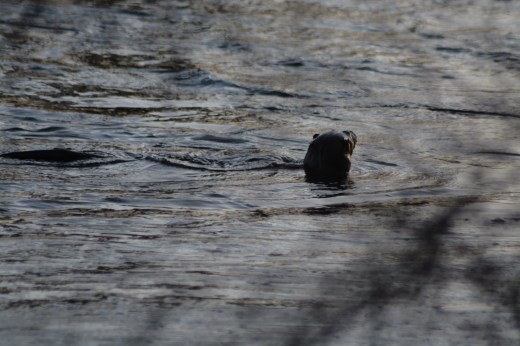
The old Celtic saints often looked around themselves at God’s creation for inspiration. These days many Christians are afraid to do so publicly because evolutionists have claimed the realm of nature for themselves. Yet I find that God can often speak through nature. Sometimes through a landscape, at other times through the animal kingdom. In the last couple of days there has hardly been a cloud in the sky. There should have a baptism in the fellowship that I belong to, but the candidate did not appear. Instead it was decided to do a short open air service on a patch of open ground. I was itching to go for a walk afterwards. DSC_0125The mountains were covered in snow but the valley floor was clear. As I walked towards the River Spey I noticed some birds in birch trees as I passed them and amongst them yellowhammers which usually fly off when they see a telephoto lens but on this occasion they hung around to photographed. When I reached the river and walked along in a downstream direction I noticed a dipper on the far bank. Again it allowed me to take a few pictures. And so it went on, I also saw goldeneye and a pair of goosanders. It was late afternoon when I reached the north end of the golf course and began to head back though I was distracted with bird calls a couple of times. There is a stretch of the riverside walk where it on top of an earthen cliff quite high above the river when I heard a splash which I initially assumed must have been a fish surfacing and stopped to look what had caused it but my vision was partially obscured by the trees along the bank. There was another splash nearby and then another. I was beginning to get my eye in but it took several glimpses of the creature to realise that it was an otter because I had never seen one in the wild. My first attempts to photograph it were hindered by the trees and I had to use manual focus but the time it spent on the surface was usually so short that by the time I focused on it was beginning to dive again.DSC_0188Eventually, it came onto the bank to swallow a catch and I managed to get several shots of it before it returned to the river. It was gradually moving downstream to a place where the cliff was not so steep and by going ahead I managed to descend down towards the river’s bank and get better shots of it.DSC_0206Even so I still had to use manual focus to see through the overhanging vegetation so most shots were often slightly out of focus. The above picture is one of sharpest taken. Then it came ashore again a few yards upstream. But it was largely hidden by a fallen branch and when I took a picture the flash went off and it jumped to a position right in front of me. Its face was partially obscured by grass and I took a couple quick shots but only the second one was in focus. The flash went off both times and it was clearly disturbing the otter.

DSC_0211

I hesitated to take another picture. As I lowered the camera the animal looked me in the eye and I apologised to it for frightening it and it slowly, but gracefully slipped back into the river and out of sight. A trail of bubbles from the air trapped in its fur slowly rose to the surface was the only possible indication of the direction of travel but I did not see it surface again. I checked my watch and it was after 5:10pm. So I continued on my journey back home.

Looking back and searching for a spiritual point to this I realised that if I had skipped the open air service then I would have probably missed the otter. When we put God first he may bless us in ways that we were not expecting. I may never see an otter in the wild again, certainly this close. None of the above pictures have been cropped in any way and the ones of the otter were taken with a 300mm lens.

David Rose 2016.

Posted in Christianity, reflections, Uncategorized | Tagged , , | 1 Comment

New Birth Should Lead to Growth and Maturity 2.

10 months ago I posted a post concerning a newborn baby and his one-year old brother. Now that, then, very small bundle is crawling around and trying to stand up. He appears to be trying to emulate his older siblings who are running around. At Church this morning he crawled over to a music stand and began to haul himself up it. Fearing an accident I went over and gently held his hands and he pulled himself up to a vertical position. As he endeavoured to walk towards me I slowly walked backwards. When a child begins to attempt to walk they usually start long before their legs have the strength to sustain their weight and will collapse without warning. This did not happen on this occasion and I found myself being walked some distance away. When I thought he was beginning to tire I laid him down on his back but he soon rolled over and began to sit up. He still had plenty of energy so again when I bent down he took hold of my hands and hauled himself up and we began to walk again, this time I steered him around and went back towards where his parents were. He has some way to go before he can walk by himself but he is gaining strength in his legs daily. Last night I watched the Christian film The War Room which is about the power of prayer. Prayer has been likened to a muscle, the more we exercise it the stronger it gets. Now I have to admit that I am not the greatest of prayers and my steps are usually faltering like a young child when I try to pray formally. Lord help me pray better!

David Rose, 2016.

Posted in Christianity, reflections | Tagged , , , | Leave a comment

Sowing a Seed, in This Case Nyjer Seed.

SONY DSC

SONY DSC

Six months ago I bought a nyjer feeder because I had been advised that goldfinches are attracted to it. (The goldfinch is the one on the left and the one on the right is a siskin.) Because of their small size nyjer seeds easily pour out of a normal feeder. They are also more expensive than normal bird seed. Because of this I hesitated to put it out for a month. But when I eventually put it out nothing happened for ages. For the first two weeks nothing happened and I failed to notice any bird using. Eventually chaffinches and other species were occasionally seen pecking away but only those that also used the normal feeder. But no goldfinches. After it had been out a month I began to see siskins come into the garden to use the nyjer feeder. Now I had seen the occasional visit of a siskin to my garden since I put out the normal feeder but they were few and far between. Slowly they became a regular fixture with a couple being seen at the feeder at the same time. But still no goldfinches. More siskins began to appear as autumn turned into winter with as many as four being seen in the garden at one time. But still no goldfinches. I mentioned this to someone knowledgeable about wildlife and he assured me that goldfinches would eventually come. I did manage to photograph goldfinches in the wild in November when walking down by the river Spey.

SONY DSC

SONY DSC

Considering that illustrations of goldfinches tend to show them eating thistle seeds I was pleased to take this and other pictures. I saw these pictures as a reward for the investment in nyjer seed. Even so it was still it was frustrating not seeing them at my feeder. In December I caught a glimpse of a goldfinch in my garden but it just went to the normal birdfeeder before flying off before I could think of getting my camera. On Friday when I took in the nyjer feeder to fill it up again, I noticed a goldfinch perched in the tree above where I normally hang the feeder as if it was looking for it. Of course I had to disturb it to put the feeder back. But within a minute or two it returned along with the siskin. Before it eventually left I managed to take a sequence of photographs.

SONY DSC

SONY DSC

Photographs like the one above make the whole effort worthwhile. In the Christian media there are always appeals to sow a seed into this or that ministry. The danger lies when these calls appeal to the wrong motives. Sometimes they give the impression that ‘sowing a seed’ is a get rich quick scheme whereby God will multiply several times over almost instantly. We should not give to God for personal gain. When we gave our lives to the Lord we in effect gave him control of our wealth then it is His anyway. So in one sense God does not need our money. In part, we give to honour him, and therefore, in that way there is no need to expect a return. But we do serve a God who wants to bless us because He loves us, but that does not mean that the Christian life will be a pleasure cruise. I was impatient to get a reward when I put out my nyjer feeder and after the first month or so I began to think the nyjer feeder was a waste of time. All too often we have a timetable that we expect God to adhere to, instead we should be prepared to wait for things to happen in God’s good time.

David Rose, 2016.

Posted in Christianity, reflections | Tagged , , , | Leave a comment

Running the Race.

Paul, when talking about the Christian life, used the analogy of an athlete running a race. But many Christians seem to treat the race of life as being more of a 100m dash than a marathon. Too often those who come to Christ start off full of enthusiasm for the Christian life but al too soon begin to backslide or at least cool off in their ardour for Christ. The question arises as how sustainable is a full-on Christian lifestyle is without risking burnout? It is a bit like those who at the beginning of a major marathon race sprint ahead to escape the crowd but are nowhere after a mile or so. One of the problems with the modern church is that most of the new believers are coming to faith in newer expressions of the church where there is often disdain for traditions which are interpreted as “man-made rules.” Disciplined prayer and Bible reading eschewed in favour of waiting until the “Spirit leads,” which occurs increasingly infrequently. Paul refers to the training of the athlete and the discipline required, these days there seems to be the assumption prevalent that evidence of baptism of the Holy Spirit renders study superfluous. I do not think that Paul would agree with that sentiment. Even so when you study the history of revivals the intensity of the revival rarely continues at the highest level for more than a few months, a year or two at the most. While some seem to backslide there is also the problem of burnout, especially with those in leadership positions. It is easy to dismiss this when it affects others with excuses like having a lack of faith, working in their own strength, etc. The problem is that either that we are equally guilty of the same excuses, or we are guilty of doing a fraction of the effort for serving God as the victims of burnout. We hear of men of God who go around the world teaching the Word of God but neglect their own family back home. They may not have intended to do this but their engagements diary just overflowed before they realised it. Even in the Church we tend to measure success in worldly terms or at least tangible terms (numbers preached to, or those becoming Christians) rather than spending quality time with the family and raising godly children. Yet one of Paul’s criteria for appointment to leadership in the Church is raising up their children in the Lord. If a believer is caught up in some project there is a danger of spiritual summit fever. Summit fever is where mountaineers are so obsessed with reaching the summit that they ignore dangers rather that turning back when conditions deteriorate, often resulting in fatal results. In focussing on the job in hand we neglect others and in so doing weaken other people’s faith who should be closer to us. The fact is that if we believe that God loves us and cares about us then we should be able to live in His will in a sustainable way that lasts a lifetime rather than do things that either harm us or those around us.

David Rose, 2016.

Posted in Christianity, reflections, Uncategorized | Tagged , , | Leave a comment

A Piece of the Puzzle.

At Christmas I received amongst other things a jigsaw puzzle from my sister. Whilst doing it there were times I was convinced that at least one piece missing. Life can be like that as well. We think that we have been dealt a short hand. It is very easy to imagine injustices, especially if we listen to other peoples’ gossip. When such ultimately groundless suspicions involve other people it is easy to see through them. But when it is ourselves then it is a different matter. Another thing that happens when doing jigsaws is convincing yourself that a piece must go somewhere it does not fit and then repeatedly trying it at the same place time after time. Sometimes we convince ourselves that we belong in role or another even though we know we do not really fit in that role. There are even times when you begin wonder if one or more pieces belong to another puzzle. There are times when people doubt that they are in the right place whether, in the church or the secular workplace. Though if a piece was from another puzzle it is usually pretty obvious as it would probably be made from a different types of cardboard, etc. Likewise, if we are in the wrong place it is usually pretty obvious. When the puzzle is completed then all these doubts are forgotten. Paul uses the analogy of parts of the body on more than one occasion. Though having a travelling companion in Luke the physician might have had something to do with it. When a jigsaw puzzle is completed then you see the whole picture. God has the whole picture of our lives and/or the Church but we rarely do.  The problem with life is that we do not have the complete picture. At times we may feel we are working without any picture. We may find a few pieces that go together but are not sure as to where they fit in with the rest of the puzzle. It is easy to concentrate on only a small part of it at a time and try and make sense of what we can. Going back to Paul’s analogy of the body we might be confused as to which part of the body we actually are and we are trying to fit ourselves into the wrong part. God wants the parts of His Church to fit together. The problem through history is that man’s idea of what the Church should look like has had little resemblance to God’s idea revealed in Scripture. We then wonder why the pieces do not seem to be fitting together correctly. It is not helped by the fact that of those churches referred to in the New Testament most were far from perfect themselves in some aspect or other. What in effect we should be aspiring to is the best practice among them and not necessarily any one church.

David Rose, 2016.

Posted in Christianity, reflections | Tagged , , | Leave a comment