The Apostle Paul uses the analogy of individuals within the church being likened to different parts of the human body, in his letter to the Corinthian church known as 1st Corinthians in Chapter 12 verses 12 to 31. This concept is of a medical nature so it is not unreasonable to assume the idea behind may have originated with Paul’s companion Luke, who was a physician as well as the writer of two books of the New Testament. So far so good. We do not hear much about Luke himself in Scripture but he must have had a good intellect in order to write his Gospel and the book of Acts. It would be a mistake to dismiss him as a nonentity because his chose not to blow his own trumpet. I suspect that part of Luke’s role was not just to be Paul’s doctor but also as his sparring partner. I suspect that Luke first used this analogy with Paul because Paul expected other believers to be just like him and became frustrated when they did not quite get his arguments. I wonder how many times Luke had to say to Paul “You can’t expect everybody to be just like you.” Then going on to explain how all the different organs of the body are needed for the body to function well. In part, I suspect, Paul when he used the analogy he was preaching to himself, it was a message he needed to learn himself. In verse 21 Paul argues: ‘So the eye cannot say to the hand “I have no need of you!” Nor can the head say to the feet, “I don’t need you!”‘ We assume that when John Mark left prematurely on Paul’s first missionary journey that the fault lay entirely with John Mark. Before Paul set out on his second missionary journey he told Barnabas that he had no need of John Mark. Yet by the end of his life in 2 Timothy chapter 4, he could ask Timothy to ask the same John Mark to come and help him because Paul found him useful. So just maybe some of the reason for John Mark’s return home early lay at Paul’s attitude towards John Mark?
David Rose, 2016.


 This winter we have been invaded by hundreds of foreign migrants from Scandinavia and Russia. These feathered migrants are welcomed by nature enthusiasts. The birds pictured here are waxwings that originate in Russia. Attempts to photograph them have been frustrated by their habit of perching high up in trees and then all too often being spooked by either the click of a camera or some other movement. This year they have been numerous here in the Cairngorms unlike previous years. I caught these birds in the late afternoon sunshine. More of them were in a taller tree adjacent to this one and after a while I noticed some birds diving behind a nearby building which turned and returning to the trees. Out of sight was a Rowan tree.
 The waxwings were feeding on the berries and I managed to get a couple of shots of them feeding before they flew off. Funny though when the question of human migration comes up it tends to produce screaming headlines and negative feelings. Just a thought. Not that there is any easy solution.
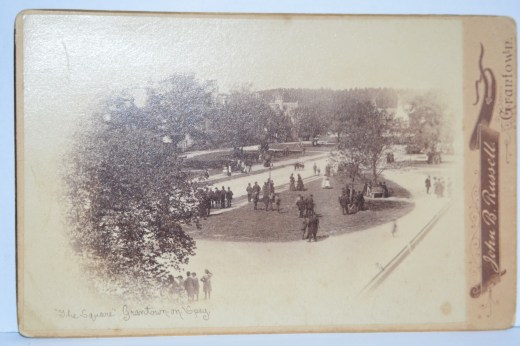 As well as taking photographs I also collect old pictures and postcards of the area. I recently purchased a late 19th century photo of the Square in Grantown a dozen or so miles to the north down the Spey. It was taken by the then local professional photographer, John B. Russell. most pictures of the square will have a few people dotted about, but this one has quite a high number of people in it. This raises the question of why they were there? They appear to be largely stationary at a time when exposure time was so slow that any movement rendered figures a blur. They seem to be waiting for something or somebody. Curiously most of them are looking away from the camera. To solve this riddle one needs additional information, especially if one is unfamiliar with the area and its history. One possible clue is that the road entering the square towards which most of them appear to be looking is called Castle Road. The castle in question being Castle Grant the residence of the chiefs of Clan Grant, the Earls of Seafield. The dress of the people suggests that they are well-to-do which in turn suggests that they are well-heeled summer visitors. Yet the random grouping would also seem to deny that anything formal was about to happen. I suppose you could try and explain it by proposing that the photographer had asked them to stand still and look down the road but that is highly unlikely given his lack of social status. Initially, I believed that the answer was that a member of the Seafield family, possibly the Countess was expected to pass by. But I made the mistake of showing the picture to a friend who pointed out a few things that I missed. Firstly, that the figures nearest the camera were boys wearing kilts. As the picture was taken from the Orphanage it begs the question if they were some of the orphans, even though they were apparently well-dressed for Victorian orphans. Secondly, they seems to be a body of people at the entrance of the square but they are very indistinct. My friend using a magnifying glass thought they were soldiers with kilts on. However, they are partially obscured by the leaves and branches as well as being affected by the slow speed of negatives in those days.
