“Touch not the Lord’s anointed?”

JUST A REMINDER: DAVID SAID “TOUCH NOT THE LORD’S ANOINTED” WHEN HE SPARED SAUL’S LIFE AND NOT WHEN NATHAN CONFRONTED DAVID ABOUT HIN WITH BATHSHEBA.

Recently I was listening to a Youtube video when the woman who runs the channel was commenting on some of the negative comments she has received. One of them she quoted included the phrase “Touch not the Lord’s anointed,” because she was criticising some Christian leader or another. This phrase tends to be trotted out every time a Christian leader is involved in some sort of scandal. But do the people who say this even know the context of when it was first said? Especially, considering the modern Christian is so biblically illiterate. David actually first said it in 1 Samuel Chapter 24 when he was urged to kill King Saul by his men when they were trapped in the back of a cave. Saul wanted to relieve himself and entered the cave unsuspecting that David and his men were inside. Instead he spared Saul but he did cut the corner of Saul’s robe off and then rebuked his men for wanting to kill Saul. But the way the phrase is used today you would think that he had said it to Nathan when he confronted him about his sin with Bathsheba and the murder of Uriah the Hittite.

So what did David originally mean by the phrase? Maybe it would help if we asked what would have happened if he had killed Saul? It might seem a good idea but outside the cave was Saul’s army, no doubt commanded by Abner, who would have wanted to take revenge on the death of his kinsman. So while David might proclaim himself to be king amongst his men it was liable to be very short-lived. In other words it would be a pretty dumb idea to kill Saul on this occasion at least. Another reason is that David might also been concerned that killing Saul might become a precedent that might inspire some of the malcontents that had joined him while he was on the run from Saul. David never again got trapped in a cave or another situation by Saul which suggests that he thought the odds were against him

The second occasion is given in Chapter 26 when the Lord causes a deep sleep on Saul’s army and David and Abishai crept unnoticed into Saul’s tent when David again refused to kill Saul, but instead he took his spear and water jug. Here the fear of being a precedent seems to be the main reason though there were probably others. Such as a fear of waking the rest of the Army.

Yet today it is almost exclusively in situations where a Christian leader is being confronted either theological errors or malpractice, and their defenders attack their critics with this misappropriation of Scripture.

The lesson from history is that just because sin seems to be beneficial in the short term its consequences outweigh them in the end. On the two occasions David used the phrase he was ignoring his followers urging that would have resulted in sin. When David was confronted by Nathan instead of saying “touch not” he said “create in me a clean heart.”

David Gordon Rose, 2025.
Posted in Uncategorized | Tagged , , , , | Leave a comment

Instant Spiritual Maturity?

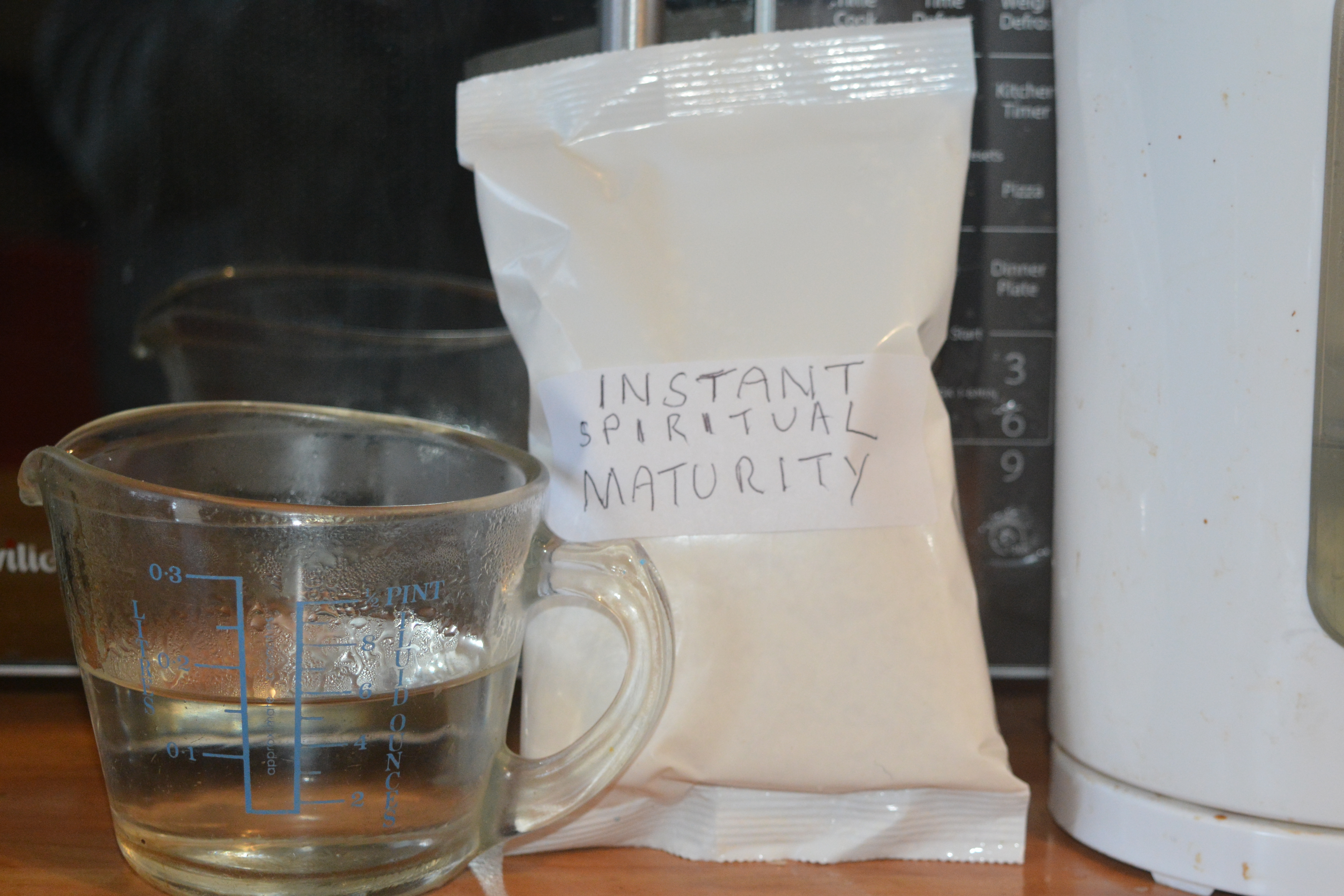
Note for anyone from Trading Services I am not trying to sell a product, it is just a prop, though if it was real I could make a fortune.

In my previous post I introduced the concept of Spiritual Colour-Blindness, a condition of those who find an inability to see “red flags” which should warn them that something is wrong. In fact, they are more likely to see it as a confirmation they are on the right path. But you might well ask what is the connection with the above title? We live in an age when people are very busy and look for short-cuts. However in the Christian life spiritual maturity can only be achieved by reading the Bible and studying it. But the temptation is to look to other sources that appear easier. This will take different forms depending on the type of church they are in. It might just mean looking for someone they can listen to, initially they will listen critically, but the danger is that they treat this person as a guru and absorb every word without checking the context of any verses quoted. Linked to this is the ease that Christians can use the Christian media, whether radio, television or internet, it is all too easy to use it without discernment. But if you use them as a substitute for your own studies it is very easy accept what is being told with apparent authority. Sometimes we like our namesake in the Pilgrim’s Progress when we meet somebody offering an apparently easy alternative as did Worldly Wise Man the only difference is that they do not realise that they are on the wrong path for a long time because they are fooled by “Christianese.” How the Gospel of grace is being subtly changed into a gospel of works without them detecting the change. To notice that something is wrong will require a degree of effort to correct it and therefore there is a tendency to ignore it. For those on the Charismatic or Pentecostal end of the spectrum there are a whole lot more pitfalls, including the prophetic. What could be easier than finding a ‘prophet’ who can tell you everything you want to know without opening a Bible ever again? I am being cynical here, but it comes with old age. It reminds me of a time when I was a child back in the Sixties and watching an old black and white television programme and at the end one of the characters said to another character the line- “the easy dollar is often very hard to get.” The same can also be said in the spiritual realm.

David Gordon Rose, 2024.

Posted in Christianity, reflections, Uncategorized | Tagged , | Leave a comment

Spiritual Colour-Blindness

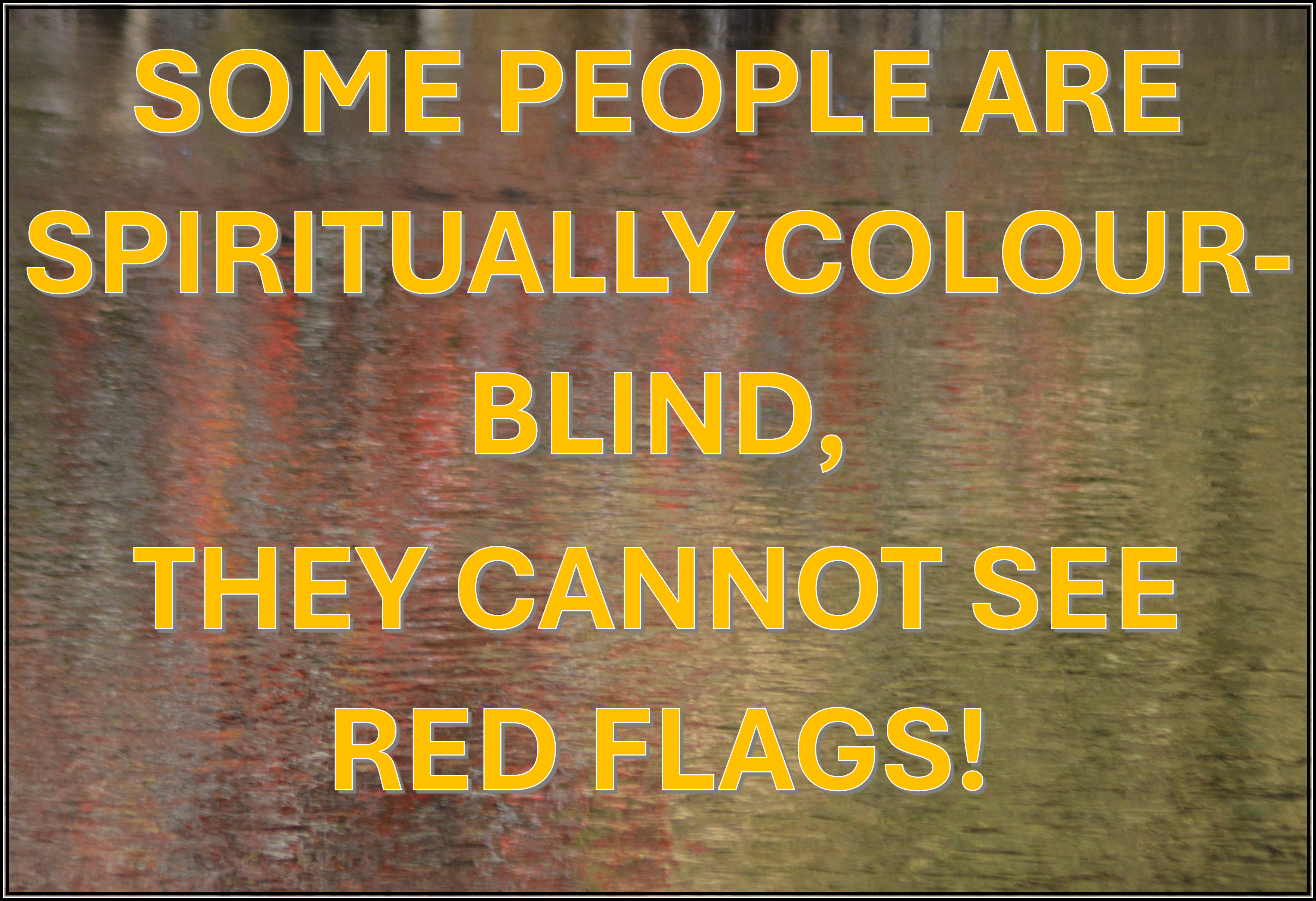
Apologies for not posting anything recently. I am not sure the phrase “spiritual colour-blind” has been used before, if not, then I coin it here. The subject of this post is in part because of my interactions with a certain person who will remain nameless, but also from watching Youtube videos about people who have left cults. In which there have been comments to the effect that some of those leave one cult end up in another. The person I previously referred to seemed not to notice red flags. In fact, on one occasion cited a book called “Prophetic Evangelism,” which encouraged Christians to switch off the left-hand side of the brain which is the centre of critical thinking. Clearly the Bereans who checked Paul’s preaching with the Scriptures, if this were true, should have been censured by Paul rather than commended. Most people when they have come a cropper having ignored a red flag will react along the lines of “once bitten, twice shy.” Yet if critical thinking is thought of as doubt which through a leap of logic is treated as the sin of unbelief. Suddenly you can see why some people choose to ignore things which most would see as red flags. To question is seen as a lack of faith, especially if they are under the influence of those imply that their followers will lose their salvation if they do not follow their rules. I hope to continue this in other posts and explore potential reasons for this phenomenon. If you have encountered people who are like this share this post. In the meme illustrating this post I deliberately used the word “people” rather than Christians” because while those whom I am referring to in this post think they are Christians, they may have heard such a distorted version of the Gospel that they may not be truly saved

David Gordon Rose, 2024.

Posted in Uncategorized | Tagged | Leave a comment

Are Daily Devotionals the Spiritual Equivalent of Highly Processed Food?

We are often exhorted to eat healthily though that is easier said than done as there is often confusion as to what is actually healthy as advice is constantly changing. One of those food types that nutritionists often are processed foods as opposed to raw natural foods. But what about spiritual food? Many people use daily devotionals and should say straightaway that I am not going to criticise any individual devotional, rather this post is about how people use them. The spiritual food we should be taking in is the Bible, the Word of God. Daily devotionals are usually short pithy pieces which if used properly whet the appetite for reading and studying the Bible. They often include extracts from the Bible or a story that exemplifies Biblical principles and are designed to be readable. But as such they are highly curated and edited to fit into a bitesize nugget. They are snacks but not the main course. Snacking is what nutritionists often target first to cut down the calories. But they also stress a balanced diet. The problem is that Christians tend to talk about reading the Bible more than actually reading the Bible. Reading a devotional may give the impression that they are reading more of the Bible than they are. As some devotionals are produced by ministries as a means of encouraging their supporters which is understandable there is a danger that they tend to say things that have a positive spin to things. Now I have to admit there have been times when it is good to read something positive before you get out of bed in the morning. However, if that’s all you read then it gets rather saccharine. Paul was exasperated when First century Christians refused to be weaned from spiritual milk to spiritual meat. I just wonder what he would think of today’s Christians, some of whom be horrified with his metaphors and ask for a spiritual vegan option instead. We live in a society where we want everything to be as convenient as possible and it is all too easy to think that because you have read a devotional that has contained a Bible verse or two that you have “read the Bible today.” There are too many people looking for a quick and easy way to spiritual maturity but like the “easy dollar” they find in the long run that it is hard to get.

David Gordon Rose, 2024.

Posted in Christianity | Tagged , | Leave a comment

John Chapter 9: Cognitive Dissonance and Cancel Culture.

Small copper butterfly.

The terms “cognitive dissonance” and “cancel culture” are modern ones, but that does not mean that there are not examples in Scripture. The first term refers to where people find it difficult to comprehend the evidence of their own eyes. In John chapter 9 there is the account of the man who was born blind whom Jesus then healed. After a question from his disciples as to why he had been born blind Jesus healed him by telling the blind man to go to the pool of Siloam and wash. After doing this he returned to where his home was seeing but his neighbours had difficulty in accepting his healing:-“His neighbours and those who had formerly seen him begging asked. “Isn’t this the same man who used to sit and beg?” Some claimed that he was. Others said, No, he only looks like him” But he himself insisted, “I am the man.” Though, if you think about it there are at least two reasons why they might conclude initially that he was somebody who just looked like the man. Firstly, a blind man without the slightest bit of vision does not look directly at the person they are engaging with so for the first time his neighbours would have seen his eyes focus on them. The second is possibly more obvious is that he would now walk like a normal sighted person. He had to insist that he was indeed the same man. But there was also what we often call “the elephant in the room” which is not overtly stated. Jesus had performed this miracle of the Jewish sabbath. This was undoubtedly in the back of the minds of his neighbours. So they took the man to the Pharisees to investigate his healing, possibly passing the buck to decide whether it was of God or not. On a previous occasion Jesus had challenged the Pharisees when there was a man with a shrivelled hand if it was right or not to do good on the Sabbath and they remained silent but walked out after Jesus healed the man. The Pharisees that the neighbours brought the man who had been born blind to may not have been the same individuals but their mindset was the same. After the man explained how he had been healed, possibly leaving out details that the Pharisees might have a problem with such as the distance he might have had to walk to the pool of Siloam. The initial response was “this man is not from God because, for he does not keep the Sabbath.” Others countered this by asking:- “How can a sinner do such miraculous signs?” Though this may have been a case of playing devil’s advocate as none seem to held on to this view by the end of investigation. They then made the mistake of asking the man what he thought of Jesus and he answered “he is a prophet.”

So the Pharisees then dragged in the man’s parents but they were on their guard. They were worried about being “cancelled” to use the modern term. They would not disclose anything further than that he was their son and he had been born blind. Because:- “His parents said this because they were afraid of the Jews, for already the Jews had decided that anyone who acknowledged that Jesus was the Christ would be put out of the synagogue.” So his parents told the Pharisees that he was old enough so they should ask him. If that isn’t “cancel culture” what is? So the parents escaped cancellation but the son was not so fortunate when he was called back. They started by saying “Give glory to God,” then said that the Son of God was a sinner. More cognitive dissonance. He replied by saying:- “One thing I know. I once was blind but now I see.” He concluded by saying, “nobody has ever heard of opening the eyes of a man born blind. It this man is not from God, he could do nothing.” they cancelled him by throwing him out because he was “steeped in sin.” They obviously did not think that the doctrine of original sin applied to them. You see that the Pharisees were so triggered by the fact that he had been healed on the Jewish Sabbath that would rather that this man remained blind. They just could not realise that they were the ones who were spiritually blind.

David Rose, 2022.

Posted in Uncategorized | Leave a comment

War Will Always Leave its Scars.

As I am writing this there is war in Ukraine and much of the news broadcasts is devoted to this. How it will all end is unclear at this time. But no doubt it will end one day. The news media will move on to the next story, but the scars will take time to heal if at all. A few days ago I was walking in woods that had been previously felled during the Second World War by men from Newfoundland. By that time bulldozers were being introduced as a means of making tracks so that the timber could be extracted. The fact that Newfoundland was sending men to fell trees rather than fight alongside the British Army was in part due to the experience of the Newfoundland Regiment on the first day of the Battle of the Somme when the suffered terribly high casualties. After the war the hillside was bare for several miles, it took decades to completely replant the woodland felled. In the meantime the tracks made the Newfies’ bulldozers were livid scars on the hillside including the one shown in the picture above. But as you can see the forest has re-established itself and the evidence of the wartime scars has diminished over the years. From the valley below there is no sign of this track.

Sadly, there is no indication that a lasting peace ill happen anytime soon, especially a just peace. Though the emphasis of the action appears to be shifting further east. However, we need to be careful that we are not fooled by propaganda which is coming from both sides. There are claims and counter claims concerning “war crimes.” Though by invading through the Chernobyl radioactive exclusion zone it could be argued that the Russians have committed a war crime against their own soldiers, many of whom seem to have suffered severe radiation sickness if reports are true. This is unusual if not unique.

The wounds are too raw at the present time to begin the process of reconciliation and forgiveness, much as the outsiders we are might wish. Jesus told us to love our enemies and to reconcile with those we are in dispute with. But I doubt that many Ukrainians feel like forgiving the Russians who have invaded their land any time soon. A just peace must come first, but this does not appear to be likely to happen any time soon. Even so the scars will remain though they may not be obvious.

David G. Rose, 2022.

Posted in Uncategorized | Leave a comment

The Fear of the Lord is the Beginning of Wisdom.

Today the word fear has negative connotations, however, when put in perspective it can be a positive thing. This is true when we hear the verse about the fear of the Lord being the beginning of wisdom (Proverbs Chapter 1 verse 7a). But there are always some people who go out of their way to interpret a verse of the Bible in the most negative light including this one, seeming to think that fear here is synonymous with dread. Rather, I would put it like a warning that one takes heed of like the following example. There is a road drain near my house and I have a fear that when returning to my house that as I put my hand into my pockets to get my keys out that they will accidentally fall down the drain. I have lived in this house for over twenty years and so far it has never happened. Quite simply I can easily avoid my fears coming to pass by waiting till after I have gone past the drain before reaching for my keys. If, however, I was so worried about losing my keys down the drain that I refused to leave my house you would question my sanity. The fear of the Lord is meant to warn us from doing things that have serious consequences. Not a dread that should stop us from doing the right things, after all Jesus had no kind words for the man in the parable of the talents who from fear did nothing.

In tension with this is Paul’s exhortation in Philippians chapter 4, verses 6-7:- “Do not be anxious about anything, but in everything, by prayer and petition, with thanksgiving, present your requests to God. And the peace of God, which transcends all understanding, will guard your hearts and minds in Christ.” So not being anxious does not mean being complacent and doing nothing just as the fear of the Lord does not mean that Christians should be paralysed with fear. Interestingly, high levels of anxiety reduce the immune system and anxiety related conditions are listed amongst the co-morbidities in the Covid 19 pandemic. As an aside, one does wonder whether those parts of the media that have ramped up the scare-mongering might find themselves being sued by the relatives of those with anxiety related conditions who it might have arguably died as a result of their scare-mongering?

So fear in proportion is not necessarily a bad thing. Unfortunately, the word phobia tends to be misused these days by propagandists of lobby groups that somebody who does not agree fully with them is suffering from a paralysing fear. In view of this it is not surprising that there is confusion as to where on the scale of fear from a mild concern to a morbid dread does the word “fear” in Proverbs 1:7 fall.

David Rose, 2022.

Posted in Christianity, reflections, Uncategorized | Tagged | Leave a comment

God Has No Grandchildren.

The above is a phrase that is often heard in Evangelical Christian circles. It is one of those sayings that you could forgiven for thinking that there was actually a verse of Scripture. But there is a section of the book of Judges that makes me think of that phrase. The chapters in question are 17 and 18, but it is only at the end, when the punch line is given that one will see why. So be patient if you are unfamiliar with these chapters.

I could also say that this post is one of an occasional unofficial series on parts of the Bible or Bible characters you rarely, if ever, hear preached on. Chapter 17 starts with a man called Micah who admits to his mother that he has stolen a load of her silver. When he returns the silver, she decides to “dedicate it to the Lord” by commissioning an idol to be made out of it. Obviously not getting the memo that idolatry was forbidden. He then compounds this by appointing his son as a priest. This is summed up by verse 6 which states that “in those days Israel had no king; everyone did as he saw fit.” A verse that is often quoted without its context. Then its gets worse when a Levite turns from Bethlehem and Micah then appoints him instead. At which point (chapter 18) the Danites who were given land to settle along the Mediterranean coast where the Philistines lived decided, after Samson died, to call it quits and find somewhere where the natives were more conquerable. They sent out a party to search out possible victims and they headed northward and passed through the territory of Ephraim where Micah lived. As they passed Micah’s shrine they enquired of the Levite who they recognised because they living amongst the people of Judah in the meantime. He told them their journey would be successful. It was, and after they duly reported back an expedition was mounted to wipe out the people of Laish which would be renamed Dan. On the way the Danites steal Micah’s Idol, but the Levite woke up and tried to stop them. But they said that if he went with them he could be the priest to a whole tribe, he then agreed and went with. Micah and his neighbours tried to chase after them but had to back down when they realised how badly they were outnumbered. So the Danites went on their way and succeeded in conquering Laish and duly set up Micah’s idols with the Levite as their priest. But the identity of this Levite is then revealed as Jonathan, son of Gershom, the son of Moses.

The first time you read through the book of Judges this hits you like a punch in the stomach. You think how could the grandson of Moses be so stupid as to officiate in idol worship. Now if you are a first generation Christian you might think so what? But for those who have been brought up in Christian families who can trace back a long line of believers it is troubling to think that family traditions could so quickly be abandoned. However, it is worthy to note that the motive that drove Jonathan the Levite to compromise was money, Micah promised to pay him, and then status when the Danites offered to make him the priest of their tribe, no doubt with commensurate reward. Sound familiar?

Unless a preacher is charged with systematically goes through the Book of Judges he is unlikely to choose to preach from these chapters, because there is no feelgood message that can be drawn this passage. Though it is possible to learn from these episodes as a warning as to how easy it is to go astray. As Paul said all Scripture is God-breathed.

David Rose, 2021.

Posted in Christianity, Uncategorized | Tagged , | Leave a comment

A Question of Perspective 2

A few weeks ago the River Spey burst its banks as a result of rain and snow melt. Its height fluctuated over several days by the time this was taken it was on the way down again, but it was still way over its normal level. After taking a few more pictures I decided to go up the hillside above Aviemore called Craigellachie and look down on the flooding.

Having previously posted pictures of the flooding on Facebook and received a number of likes and comments I was somewhat surprised that nobody responded when I posted the two photos above. On reflection I recognise that the second photograph put the other pictures I had in perspective. The flooding does not look so bad up here. I am reminded of the verses in Isaiah chapter 55, 8 and 9, “For my thoughts are not your thoughts, neither are your ways my ways,” declares the Lord. “As the heavens are higher than the earth, so are my ways higher than your ways and my thoughts are higher than your thoughts.” Funny how when we are confronted with a problem in our lives we tend to throw a pity party. We live in a “me centred” culture in Western Christianity which has also infected the Church in many ways, sometimes subtle but at other times more obvious. We want to live in a world where everything revolves around us, but forget that when Jesus said he was the Light of the World he knew the solar system was heliocentric. We need to take a few steps back and try and see things from God’s perspective.

David Rose, 2021.

Posted in Christianity, reflections, Uncategorized | Tagged , | Leave a comment

“The Angel of the Lord.”

Airgead Meall one of the foothills of the Cairngorms

There are times when the high tops of the Cairngorms are obscured by clouds, but on occasions some other lower feature is highlighted by a break in the clouds as in the photograph above. Equally, there are times when God will highlight some of his attributes which we would consider lesser ones.

In 1 Kings 19 verse 7 it states that “the angel of the Lord came back a second time and touched him [Elijah].” Now the phrase the “angel of the Lord” occurs many times in the Old Testament and can be used on occasions to refer to the pre-incarnate Christ. But I have never heard anybody cite this occasion as being one of them. After all the angel is performing a relatively menial task of cooking a couple of meals for Elijah whose courage had failed him. The angel makes no great prophetic utterance and in fact on the first occasion the angel wakes up Elijah the words “of the Lord” are omitted. But a year or so ago I heard a preacher quote verse 7 and the thought dropped into my mind that the phrase ‘angel of the Lord’ could mean the pre-incarnate Christ. I began to react against this being applied in this instance because God would not come down to earth to serve a failure like Elijah. But then I was reminded of Jesus washing the disciples’ feet at the Last Supper. Immediately I was also reminded of John chapter 21 and the miraculous catch of fish, with Jesus cooking a meal the the disciples including Peter who had betrayed Him. Suddenly the idea of Jesus cooking the meal for Elijah did not seem to far-fetched after all.

Of course, we assume it was just an ordinary angel and we equally assume that God must have been angry with Elijah for doing a runner. Elijah was probably angry with himself for his failure, but just because we might be mad about our failures it does not necessarily mean that God was angry with Elijah or us. I mean that Jesus had every right to be angry with Peter for denying him three times and most of us would have found it difficult not to be in the flesh. Of course God knew that Jezebel would react in the way she did threatening Elijah with his life, even if it was the last thing that Elijah was. God knew how disappointed Elijah would be so why would He be angry with him? So maybe it was a way of showing Elijah how sympathetic God was to Elijah’s dejection. Even if Elijah was so deep in his “pity party” that he did not notice that the angel who served him was God Himself. Elijah may have assumed that the angel who fed him was the lowest of the low.

What we forget is that God loves the “servant heart” and wants to see it in us, but because of our sinful nature we want to be in control, and are therefore blind to the possibility that God Himself would humble Himself to serve Elijah. We would see the washing of the disciples feet as as one off, as again we would see Jesus suffering on the cross as the “suffering servant” of Isaiah 53 as a one-off. But Jesus’ whole life on the earth was one of humility. Think, why Jesus’ severest criticisms were targeted against those who thought themselves self-important and want to lord it over others? Does it not show something of God’s nature and how He expects His servants to behave?

Apologies for a period of writers’ block and overcoming inertia.

David Rose, 2021.

Posted in Christianity, reflections, Uncategorized | Tagged , , , | Leave a comment