Reflections on the Cross – Part 5 Mourning for the one they have pierced.

The portion of scripture that appears in our Bibles as Zechariah Ch 12 vv 10-4 is generally seen as a prophecy concerning the Second Coming of Christ even though John quotes this passage in his gospel. But I listened to Derek Walker (Oxford Bible Church) state that prophecies concerning the first Coming will also apply to the Second Coming. So it occurred to me that this prophecy might also apply to Christ’s first Coming. Verse 10 states “And I will pour out on the house of David and the inhabitants of Jerusalem a spirit of grace and supplication. They will look on me, the one they have pierced, and they will mourn for him as one mourns for a only child, and grieve bitterly for him as a firstborn son.” The Spirit was poured out at Pentecost. Of the 120 who were in the upper room at that time how many had been in Jerusalem for the previous Passover? Most, if not all, could have been. but then one could argue that only Mary His mother was mourning for him as a firstborn son. Even his brothers were sceptical as to Jesus’ claims to be the Messiah. While verse 11 seems to refer to future battle on the plain of Megiddo (Armageddon?), verse 12 could apply to the crucifixion:- “The land will mourn, each clan by itself, with their wives by themselves: the clan of the house of David and their wives,” Now Joseph the husband of Mary was of the house of David but he had apparently died before Jesus started his ministry but there is an early Christian tradition that Cleopas(Clopas) to whom Jesus appeared on the road to Emmaus was a brother of Joseph. His wife Mary is mentioned in John’s Gospel as being at the cross. (How accurate the tradition I do not know but as Scripture states that Jesus appeared to his brothers after the Resurrection it does not contradict it at least.) Verse 12 continues:- “the clan of Nathan and their wives,” Zechariah may have thought that he was referring Nathan the prophet but there is another Nathan mentioned in Scripture, namely one of Solomon’s brothers and he is named in Luke’s genealogy of Jesus through the line of his mother Mary, John records that her sister was there as well. Verse 13 goes on to speak of the clan of Levi and their wives, and we know that through her cousin Elizabeth Mary was related to the Levitical priesthood. Verse 13 ends with the clan of Shimei and his wives, now Shimei was a Benjaminite who cursed David when he fled from Absalom. The New Testament’s most famous Benjaminite was Saul of Tarsus, was he a descendant of Shimei? Scripture does not say, but we know he had relatives who also believed before he did and had witnessed the risen Christ, presumably amongst the 500 that Paul referred to in one of his letters. Whether he was physically a descendant of Shimei or not Saul was very much a spiritual successor to him.

Though we look forward to the Jewish people of today recognising their Messiah but forget just how many believed in the 1st century.

Returning to Cleopas and his wife Mary on the road to Emmaus, I find the story has its comedic aspects. Mary had probably visited the empty tomb and she may not have been able to explain everything she saw it would appear that she could not rule out the possibility of Jesus’ resurrection. but her husband would have none of it Hence the argument they were having. Then a stranger approached them and Cleopas felt it necessary to protect his wife from derision. After all, what self-respecting man would accept a tale told by women, I mean, crucifixion destroys the ligaments leaving the extremities useless so he just could not have got up and walked away, never mind walking along side of him. Eventually when Jesus revealed himself one can imagining Cleopas’ face turning red with embarrassment, and his wife saying “I told you so.” Before returning to Jerusalem to inform the other disciples.

David G. Rose 2013
Posted in reflections | Tagged , | Leave a comment

Lessons from History – 2: Bannockburn.

Once a group of Scotsmen knelt down to pray. Some distance in front of them an Englishman observed them and stated:- “Look, they are bowing down before me!” His companions were silent at his blasphemy, possibly, expecting a bolt of lightning to strike. This was worrying for them especially as they were wearing armour. One of them found voice and rebuked his leader by saying that the Scots were bowing down before God and not him. The first Englishman was named Edward Plantagenet and the second the Earl of Pembroke, the place Bannockburn, the year 1314. The rest, they say, is history. Modern secularists tend to leave this incident out of their history books and documentaries. You might say that this story had no relevance to outcome of the battle. But the Earl of Pembroke commanded the Welsh archers with their deadly longbows that unleashed their hail of death upon Scottish armies for centuries. When battle commenced they were nowhere to be seen. The Scottish schiltrons advanced with discipline and pushed the English back even though they were vastly outnumbered. The reluctance of King Edward 11 to bring the Earl of Pembroke’s men from the fringes of the action until too late, unless it was out of spite for the previous reprimand, does not make military sense. However, as the Welsh archers formed up they were attacked in their flank by the Scottish cavalry, after which the battle became a rout. After the battle the earl gathered his men up and reformed them and marched them south to the English border. King Edward fled in terror and nearly all those who had stayed silent that morning were either dead or prisoners. The Earl of Pembroke was the only one who maintained a shred of honour. Leaving God out of the story, as secularists would like, will in this incident and others leaves the public misunderstanding history.

Incidentally, King Robert 1 who led the Scots in prayer that day was officially excommunicated by the Church of Rome. But God looks on the heart, He listens to those who humble themselves and not those who think they are God. On that occasion, at least, God voted ‘yes’ for Scottish independence. Unfortunately, succeeding generations of Scots have forgotten this, attributing their victory to their inherent moral superiority over the English. In later wars they would pay dearly for thinking that they could take on the English on equal terms with their infantry invariably resembling pin cushions after the English longbow-men opened up with their cloth-yard shafts. Likewise, we have to be careful that we do not look back on one incident of our past when God appeared to favour us, that He should invariably do so ad infinitum regardless of how far we may have strayed from His will.

David G. Rose, 2013

Posted in Uncategorized | Tagged , | Leave a comment

Repentance = About Turn.

ImageIn the 1920s in some far-flung part of the British Empire a Sergeant Ewan was drilling his men. One of the sides there was a precipitous drop. As the men marched back and forth they found themselves marching towards this edge, the sergeant delayed the order for the about turn, as the edge drew near the men began to fear, as the leading men were about to step over the edge he barked the command, “Repent!” The men immediately did a 180 degree turn. Later the sergeant addressed his men and told them that they now knew the true meaning of repentance – a complete about turn. This story was told to me by the sergeant’s son Edmund Ewan.

When Peter responded to the crowds at Pentecost he told them “Repent and be baptised.” Yet today the word repent has all but disappeared from the vocabulary of evangelists as what is often termed “easy believer-ism” has become prevalent. Potential believers are urged just to say a version of  the sinners’ prayer. But if you don’t mean the words you say when you pray then you are, in effect,  bearing false witness and committing another sin. There has also been a rise in the debate of whether or not a believer can lose their salvation. Could the two be connected. It is often questioned when somebody falls away from the faith whether they were truly a believer in the first place. I consider this a valid point.

Returning to our original analogy, suppose a soldier instead of doing a 180 degree turn and only did a right angle  and marched along the precipitous edge. He might justify his actions by stating that he had made a change in direction. His drill sergeant would have told him otherwise. If we are going away from God and he commands to do an about turn so that we come towards him, a 90 degree turn is not what God wants. We know we are going in the wrong direction but refuse to accept that God is right, so we make changes but not what God actually wants. It might be a start in a journey that leads ultimately to repentance.

Again, suppose a soldier realising that he was in danger if he continued in the way he was to do a 180 degree turn but after he marched a couple of steps back from the edge stopped and marched on time on the spot. Like the seed that fell on shallow ground there seemed to be a positive response but when he begins to count the cost his enthusiasm disappears. This is less than true repentance. In truth most of us when we  when we become Christians we have areas of our lives that initially we are reluctant to change and our repentance is less than complete. Sometimes the Lord will allow us to continue in some areas of our lives as before, such as hobbies and enthusiasms, for several years before challenging us on them. here the sin is not so much that something inherently evil, but rather more that something has become more important out of all proportion. When this happens we create an idol. Now God gives us gifts and talents, which it is right and proper for us to use. The danger is that we can think that these talents that we had before we became Christians are somehow sinful and we  must turn our back on them. Indeed, from listening to people’s testimonies over the years, the Lord may ask a believer to lay aside some interest or another for a season, only for the Lord to tell them again later to use it.

Another aspect of our Christian life that can be alluded to from this illustration is the fact that our walk is rarely as steady as a soldier on the march. We tend to hesitate and stumble from one issue to another. We should not be surprised at our failings and those of others, yet at the same time we should not be satisfied with our shortcomings. The failings of one who has genuinely repented can easily be confused with those with those whose repentance is only partial. I believe the Lord knows the difference because he can see our hearts. He knows when “the spirit is willing but the flesh is weak,” and when we are faking it. It is a fact that our old sinful nature will resent obeying God’s commands. There is an old hymn that has the line – “Trust and obey for there is no other way, to be happy in Jesus but to trust and obey.” As a teenager I can remember having a problem with the word “obey” and thinking whilst singing this hymn – “Are you sure, Lord?” I had to come to the conclusion, however reluctantly, that there was no alternative.

David G. Rose, 2013.

Posted in Uncategorized | Tagged , | Leave a comment

A Question of Perspective.

ImageWhich is bigger, the tree or the hill? The tree may take up a greater part of the picture but this is only because it is nearer. Likewise if we push God into the background then he will appear small. On a spiritual level one could argue that the Devil and his forces of evil can only appear big if he gets close to us. Though for most of the time it is more likely to be things concerning self that we keep close to us that make us think God as being small. It is usually things such as our work or our enthusiasms that loom large in our eyes. All too often when one tries to photograph hills or mountains trees can get in the way. One time a few years ago when trying film a southbound steam special I tried to go back to a spot on the hills above the strath where I had a clear view of the valley a couple a decades ago, but the trees had grown up and the only place I could get a good view was where it was too steep and rocky to set up my tripod. Consequently I could not get the quality footage that I wanted. Sometimes we allow stuff to crowd God out of our lives over time. Metaphorically, we need to cut down the foliage so we can see clearly again. 

David Rose 2013.

Posted in Uncategorized | Tagged | Leave a comment

Lessons from History – The Battle of Nechtansmere 685 AD

You may never have heard of this battle, let alone think that there are relevant lessons to be drawn from it. But please bear with me. There is controversy as to the site of this battle. Traditional claimants for its location are in Angus but more recently Dunnachton near Kincraig has been put forward as a potential location. I hope to address this later but first I would like to talk about the reasons that gave rise to it. It was fought between an invading Northumbrian army led by a king called Ecfrith and the Picts who inhabited the lands north of the Forth. Christianity had come to Northumbria as a result of missionaries sent from Iona along with the traditions of the Columban Church when they came in contact with those monks who adhered to rites and traditions of the Roman Church this led to conflict when they celebrated Easter on different dates. In 664 AD the synod of Whitby was held to decide which tradition the Northumbria should adhere to. The king of Northumbria was the arbiter and he decided to adopt the traditions of Rome (his wife was from the south of England where the Roman Church held sway) Twenty years later his successor decided to make his northern neighbours adopt Roman ways by force. There is a lot said about church unity these days but we should never mistake uniformity for unity. Far too often outward signs of conformity are imposed on churches for the sake of uniformity and anybody who questions it. Ecfrith thought that invasion was a good idea but it was not a ‘God’ idea as events transpired. Mobilising his army in the spring he hoped to catch the Picts before they could finish sowing their crops. The Pictish king, Brudei, would not have been able have a standing army because most people lived by subsistence farming, he would have wait for his enemy to invade before calling out all his men. Northumbria claimed authority over at least the southern Pictish tribes but subsequent rebellions in the preceding years make it difficult to judge where the effective border lay. As with later military campaigns in Scotland show there are physical obstacles to overcome such as rivers to cross. Bede suggests that Ecfrith was lured into the mountains, fought an initial engagement, managed to outflank the Picts causing them to retreat. however in the headlong pursuit of the fleeing Picts King Ecfrith was ambushed, and cut off and killed along with his warrior elite. Sometimes we can be like Ecfrith we can be so convinced that we are in the right we fail to consider that God will listen to those who disagree with us and uphold their cause. “There is a way that seems right to a man but the end thereof ends in destruction.” Matthew 7:13.
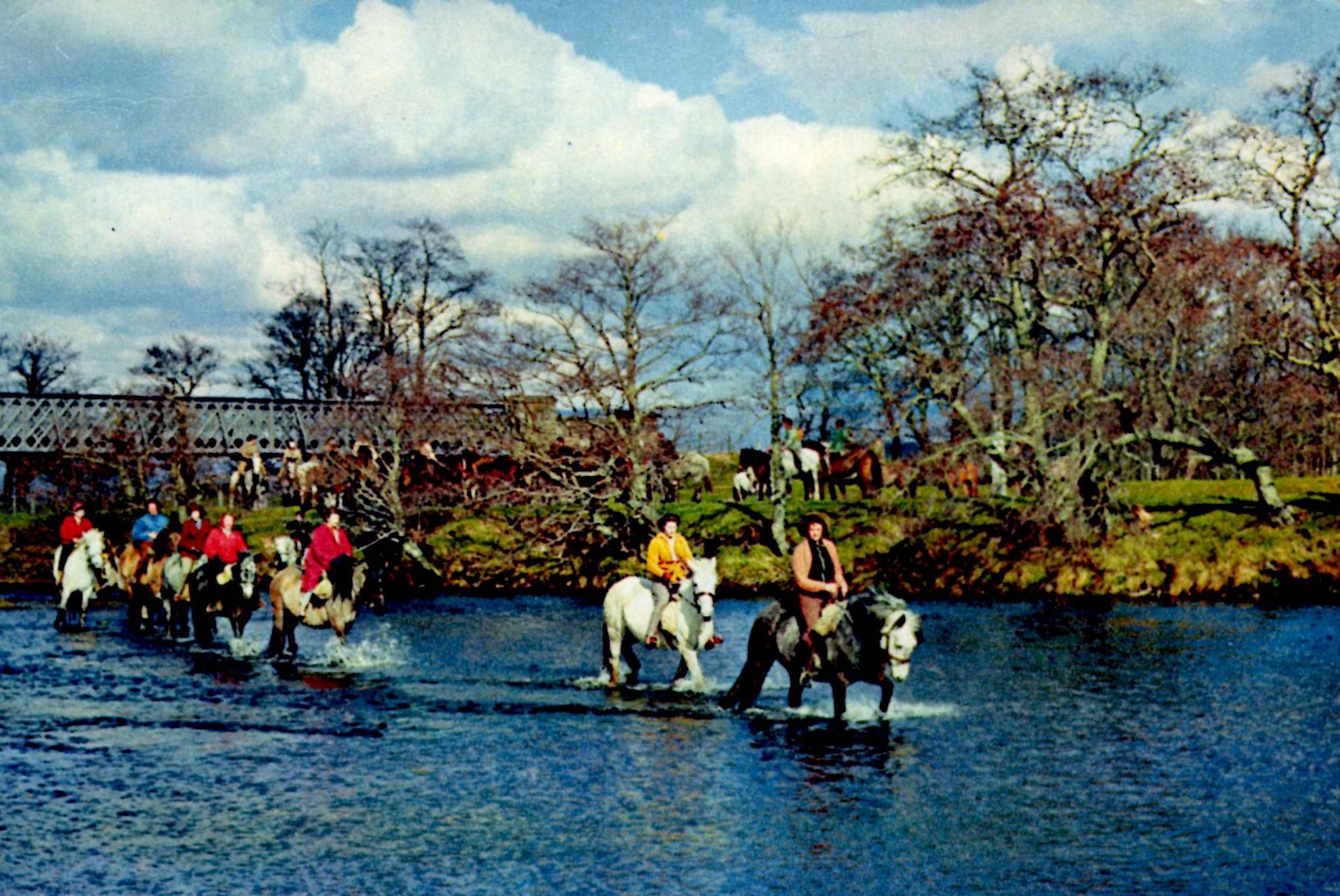
Assuming that the first line that the Picts could defend would have been on the banks of the Tay near Perth, even then only those tribes nearest would be able to mobilise in time and thus be outnumbered. However, an opposed crossing would have made Ecfrith think twice. Looking for an unopposed crossing point upstream would seem a wise thing to do. But as time progressed the more time the Picts had to get reinforcements. It is quite possible that the two forces shadowed each other. There would have been a limit to which the Northumbrians could have forced the pace to draw ahead and secure an undefended ford without wearing out his men and animals. Any stragglers would become easy victims for the native Picts. The longer this happened the greater the chance that the remoter northern Pictish tribes could meet with their southern neighbours. This fits in with Bede’s comments about being lured into the mountains. This would have led the invading army away from the more fertile lands along the east coast and the resultant hardships that would have entailed. There were, of course, no proper roads in the Highlands until General Wade came along, but he usually incorporated existing tracks. If the battle did take place in Badenoch it is quite possible that the route of the later Wade Road might give a clue. Bede describes the battle as being between two hills, it is generally assumed that these hills were on the left and right flanks of the opposing armies but as the Northumbrians were supposed enticed into the mountains of the Highlands maybe these hills are smaller geographical features in the strath rather than the mountains that surround it. Bede was writing in the next century but is possible that some survivors of battle were still alive in his youth, if not later when he was writing his history. Whose version of events would he trust the most? How about a fellow monk that accompanied Ecfrith’s army? If so then during the actual battle he may well have been on a hill overlooking the scene of the initial engagement of the battle. Two routes from the south meet up at Ruthven (Glen Tilt and Druimuachdar), so could the hill that Ruthven Castle and later Barracks were built the hill that Bede’s source was observing from? The later Wade road crossed the Spey in the flood plain below the Barracks, and north of the Spey it is now Manse Road.img016 This postcard from my collection shows the manse, manse road itself runs at the bottom of the high ground. The hill ends in a bluff over the river which would have effectively limited the Northumbrian attack to the ford at its base. The manse in question now being the Columba House Hotel is on a small hill. The view from the south is now blocked by the new A9 which now crosses the Spey close to where the Wade road once forded the Spey. The position the Picts held does must have been a logical one to defend such as a river crossing because Ecfrith did not suspect a trap. One of the features of the Spey is that there are banks of shingle at many points, to earlier generations of Highlanders these would have been seen as ammunition dumps, full of “chuckies” to rain down on attackers as they waded across the shallows. Any of the Northumbrian elite wearing armour/chain mail would risk drowning if they stumbled at this point and fell. One might argue that there is no mention about fording of any river in the accounts of the battle, true, but many rivers would have to have been crossed and they are not mentioned either. If you look at later accounts of campaigning in the Highlands, such as General Mackay’s Memoirs, where we can trace the route taken the fording on most of the rivers is hardly mentioned if at all. Today because we normally cross rivers by means of bridges we would see the fording of a river as something memorable and unusual. The account states that the right flank of the Pictish army was observed to melt away after apparently being outflanked. There is another place where the Spey can be forded near Kingussie just upstream of the Ruthven bridge, in fact, there is a colour postcard of pony-trekkers fording the Spey. img015 If the right flank of the Pictish army extended no further than the mouth of the river Gynack then the Northumbrians would have been able to ford the Spey unopposed. The path of the Gynack was channelled when Kingussie was developed as a planned town c1800. All that would have been needed for the right flank of the Picts to fold was the realisation that the Northumbrians were in force on the other side of the Gynack looking for a place to cross. But it is quite possible that this was expected and this was a planned withdrawal. Though its execution might have been flawed. The Wade Road going towards Dunnachton takes the higher ground above the Insh marshes on drier ground. But to a retreating army it would have been tempting to take the more direct route along the floor of the strath only to find oneself crossing boggy ground that deteriorate quickly as each person passed over it. To Ecfrith and his pursuing army following the Wade Road route would seem to be the long way round and going along the floor of the strath would seem to be quicker at first and they would look to cut off those retreating along the higher ground. Only to realise too late that their progress would be slowed at points to almost a standstill. As they approached Lynchat the ground would have become firmer and they would have thought the worst was over. What happened next would have depended upon states of the respective armies. Had the Northumbrian flanking force linked back up with the main army? What Ecfrith did not know was that the Northern Pictish tribes had been concentrating at Dunnachton, though some elements may have gone south to slow up the Northumbrian advance. Giving Ecfrith the confidence that he was facing the entire Pictish army. A confidence misplaced. He marched his men into an ambush. But where? You need something like a hollow in the ground where a large body of men could emerge in surprise to cut off and destroy the invaders. There are a couple of potential sites, there is one on the eastern side of Lynchat marked on the first OS map as the site of a sluice and another one slightly further east towards Balavil House. If Ecfrith and his vanguard had not waited until most of his men emerged from the marshy ground then the Northumbrians were probably strung out and therefore easy meat for the ambushing forces. Especially if he was focused on the retreating men who may have suddenly turned to make a stand. Ecfrith may have thought they were preparing to make a final stand but in reality it was because the trap had been sprung and he and his men were doomed. The former hollow was protected by a band of trees stretching down from the hillside above (probably left uncultivated because of its steepness), which was recorded in the Roy map of the area which was produced after the ‘Forty-Five. This could have provided additional cover for an ambush.
One might raise a number of objections such as the site of the proposed action it is far from Dunachton to be the battle site but not all battles were fought at the place they are popularly named after. The village of Waterloo did not see any of the actual fighting during the Battle of Waterloo in 1815. The battle was so-called because the victorious Duke of Wellington had spent the night before there. Just because the Picts were defending Dunachton does not necessarily means that the fighting took place at Dunachton itself. From Ruthven you can look down the strath and see Loch Insh in the distance and hence Bede’s source called the battle of Nechtansmere.
What happened to the rest of the Northumbrian army history is silent on it, it could have been that King Brudei was magnanimous and allowed them to return home knowing that many Northumbrians still observed the traditions of the Columban church, or at least had a great respect for it. After all somebody had lived to tell the tale. But Bede had no reason to put the Picts or the Columbans in a good light. Sometimes we have to see the good in different strands of the Christian Church, too often we see only the faults of other denominations and try and impose our own ways on others. We have be careful that we do not do an “Egfrith” and find that God blesses those we consider our enemies.

Posted in History, reflections | Tagged , | Leave a comment

Lessons in Metamorphosis – Part 2

SONY DSCThe above photograph is a picture of a pair of dragonflies mating, and it only when mating that dragonflies and damselflies contort their bodies in such a way. I came across the following section in the Collins Complete Guide to British Insects concerning how their reproduction takes place:- “Dragonflies and damselflies exhibit a mating routine all of their own. Although the male reproductive organs are in the normal place at the end of the abdomen, his copulatory organs are at the front of the abdomen, and before going in search of a mate he has to transfer sperm to them from the tip of his abdomen. This then leaves him free to grab a female by the neck. She then bends her own body round so that the tip of her abdomen makes contact with the male’s copulatory organs to collect the sperm. This position is known as the copulation wheel.” When I read this it struck me that such a mating routine would be almost impossible to have evolved by random chance. Insects behave by instinct and not by reasoned contemplative thought, so basically the first generation of any species of dragonfly would have only one chance to reproduce or die out. Surely it is more logical that this method of mating was pre-programmed into its DNA by a Creator God so that it will be instinctive. According to information theory for raw data to become information it requires intelligence, that as far as DNA is concerned can only come from the Creator God – the God of the Bible.
David G. Rose, Aviemore 2013.

Posted in reflections | Tagged | Leave a comment

Time

SONY DSCThe ephemeral nature of the world we live in can be display by a leave turning into autumnal colours. Solomon in Ecclesiates chapter 3 “There is a time for everything and a season for every activity: a time to be born and a time to die.” Inspired by this passage a friend called David Heath wrote piece/poem entitled “Take Time” hope you like it:-
Take Time to Laugh:It is the music of the soul.
Take time to think:It is the source of power.
Take Time to play:It is the source of perpetual youth.
Take Time to read:It is the fountain of wisdom.
Take Time Time to be friendly:It is the road to happiness.
Take Time to give:It is too short a day to be selfish.
Take Time to work:It is the price of success.
Take time to love and Be loved:
It is a God-given privilege.
ABOVE ALL ELSE:
Take time to Pray:It is the Greatest Power on Earth.
David G. Rose 2013

Posted in Uncategorized | Leave a comment

Reflections on the Cross – Part 4. “What Must I Do To Be Saved?”

In Part 3 when I asked the question concerning whether God would make provision for the salvation of the men responsible for Jesus’ actual crucifixion I did not answer it. In short I believe the answer to be yes. But there was a problem which Paul raises in Romans (appropriately enough) chapter 10 verses 14 and 15a:- “How, then, can they call on the one they have not believed in? And how can they believe in the one of whom they have not heard? And how hear unless they are sent without someone preaching to them? And how can they preach unless they are sent?” But the early church in Jerusalem made no attempt to evangelise the Roman Army which occupied their land. They only started to evangelise the Samaritans when persecution forced many of the believers to take shelter among their neighbours whom they normally despised. No doubt they shared their faith as much as to explain why they were being persecuted rather than out of compassion for the lost souls of the Samaritans. The Jerusalem Church was forced to admit that Jesus had died for the Samaritans too. Cornelius was an officer who was already seeking God, but it needed a vision from God before Peter thought that the Gentiles were worth the Gospel preaching to.But reaching lowly legionaries was not something high on the list of the average Jewish believer. But are we any better as Christians when expect unsaved people to turn up at our churches?
A Roman soldier enlisted for 25 years and those men who found them selves in an execution squad would not have been raw recruits, especially its most senior member who was probably the one whose spear had pierced the Lord’s side. When his term of enlistment came to an end where would he retire to? If he was fearing retribution from the relatives and companions of the Jewish zealots he had executed over the years then he would likely to choose somewhere where there was little or no Jewish presence. How about the Roman colony of Philippi? Far-fetched? Considering that Paul’s missionary journeys took place a couple of decades or so after the crucifixion it would certainly fit into a reasonable timescale. According to the Book of Acts it had no synagogue. Though there were some Jewish women (but no men) who met for prayer down by the river. With the exception of Lydia, who was a wealthy businesswoman, these women were more than likely the partners of former Roman soldiers. Technically the Roman Army did not legally allow men below the rank of centurion to marry so that the Empire would not be liable for widow’s pensions, so these women would have been doubly condemned by their fellow Jews, being dubbed not only traitors but immoral. Philippi was different in a number of respects from most of the places where Paul founded churches, his usual method was to start at the local synagogue and persuade those who were morally respectable and use these first converts as elders for the new church. Also he had not planned to evangelise there, it was only after the vision of the “man of Macedonia” that he crossed over from Asia Minor to Europe, having been blocked from going elsewhere by the Holy Spirit. One can imagine then that he was disappointed to be sharing the gospel with women rather than debating with the learned elders of a synagogue. The church Paul founded stayed loyal to him even when all the other deserted him at the end of his life. Why did they feel they owed him more than the other churches? Could it be that within its membership there were those who had been forgiven for their part in Christ’s crucifixion? Paul’s stay in Philippi was cut short when he was thrown into jail. This led to the conversion of the jailer who asked “What must I do to be saved?” Note that the jailer did not ask not enquire as to what god Paul and Silas worshipped, this might indicate that he had previously served in the Holy Land and was familiar with the Jewish religion. Come to think of it, if you had been involved in crime and punishment in the Army what better job would be better suited for but the jailer of a Roman colony? Could his reaction to the earthquake in Acts be because it reminded him of the earthquake reported at the time of Jesus’ death? Did he think Paul and Silas were zealots out for revenge that he was prepared to kill himself? Of course if he was one of the execution squad Luke would have needed to protect his identity from those who were not so forgiving. But how else would such a man be reached?
David G.Rose, 2012

Posted in reflections | Tagged , | Leave a comment

Reflections on the Cross – part 3. “Father, Forgive Them, For They Do Not Know What They Are Doing.” Luke23:34.

When we read these words we ask ourselves at whom were they directed, everybody who witnessed the crucifixion, including those who were baying for his blood, or just the execution party? The general concensus among Bible scholars is that they are primarily concerned with the execution squad of four men who drove the nails into the Saviour. The question arose in my mind as to what provision God would have made so that these men might not die in ignorance? In Part 2 I suggested that Luke had a source closer to the cross than the other synoptic Gospel writers. Could this source have been one of the execution squad itself? Let’s look at the evidence. Would any of the Jews, who were hurling insults at Him, who were at the front of the crowd, and might have been able to understand the words Jesus was speaking, have thought that the souls of the men of the execution squad were worth saving? On the contrary they probably thought that Hell was made for Roman soldiers and would have not thought that Jesus’ words were worthy of note to recall at a later date.
Some might propose that the centurion who stated after Jesus died that he was the Son of God was the source. Though I think this is unlikely because Luke usually quotes the name of any centurion he met in person. Though have you ever considered what the impact of those words on the men who had executed Christ? To them came the realisation that they were responsible for the death of [a] god. What retribution did they fear in the afterlife? You can imagine this preying on their minds in the years to come. There is, however, one incident concerning the death of Jesus which Luke omits to tell but which John includes in his Gospel; namely that of the soldier piercing Jesus’ side and with a spear and blood and water flowed out. This observation is important as this is now recognised medically as a sign of death. But in Luke’s time it was unknown or ignored. Even so there are those who like to hold on to the idea of the “swoon theory” in which Jesus did not die on the cross but swooned only to consciousness in the cool of the grave. Are there any recorded cases of a Roman crucifixion similarly botched where the victim got up and walked away without ill-effect? The damage inflicted by the nailed would mean that even if a living person was taken down from a cross they would not be able to use their hands and feet again. Never mind rolling a heavy stone from over the grave to escape. It could be easily be argued that the swoon theory requires a greater miracle than the Biblical death and resurrection of Christ. Trying to explain one miracle away rationally often requires an even greater improbability.
Originally I thought that source did not mention the piercing of the spear because he was ashamed of his actions that day and did not want include this further indignity to the Christ, however, I now suspect Luke ignored it because it conflicted with current medical opinion. One might also ask why Luke did not name his source? The reason might have been for his personal safety because it is likely that any member of the execution squad would not just have been involved in these executions but also a great many other Jewish zealot types. The idea that Christ died not just for the Jews but also not just friendly gentiles but their enemies, was something Jewish church could not comprehend. But, then, are we any better when it comes to sharing the faith with the social pariahs of our own day? (To be continued.)
David G. Rose, 2012.

Posted in reflections | Tagged , | Leave a comment

Reflections on the Cross. Part 2:The Penitent Thief.

The story of the penitent thief is recorded in only one of the Gospels – that of Luke in chapter 23, if you are unfamiliar with it here it is:-

“One of the criminals who hung there hurled insults at him:”Aren’t you the Christ? Save yourself and us!” But the other criminal rebuked him. Don’t you fear God,” he said “since you are under the same sentence? We are punished justly, for we are getting what are deeds deserve. But this man has done nothing wrong.” Then he said, Jesus, remember me when you come in your kingdom.” Jesus answered him, “I tell you the truth, today you will be with me in paradise.”” 23:39-43.

Have you ever considered that the only person to have accepted Christ as their Saviour on the day of the crucifixion was a “thief”?

The word usually translated thief suggests a political dimension to the crime(s) they were being crucified for. If you asked for political status in Roman they would crucify you. It is generally assumed that the two thieves were Barrabbas’ accomplices, and that Barrabbas’ crucifixion was due at the same time and Jesus replaced him. One can imagine that the two thieves were less than pleased that the man who had got them into this mess had been released but they were still to die. Some of this frustration may have re-directed at the one who replaced him on the cross – Jesus. So when the Gospel of Mark states that both of the criminals abused it could have been that initially both railed at Jesus.

The other possible explanation is that Mark’s source of information was further from the cross and could not make out the words of the second (penitent) thief for all the noise made by Christ’s enemies. Note, Mary the mother of Jesus and the women who are recorded as being with her are described as being in the distance.

In order to understand why the penitent thief changed his mind one has to know what he was suffering. One has to know how crucifixion kills its victims. Firstly, the loss of blood through the pierced nails; secondly, the weight of the body pressing down on the lungs makes it difficult to breathe, never mind having an intelligent conversation. Thirdly, in order to breathe one had to place ones weight on the nail[s] through the feet which causes excruciating pain in the legs. It was designed to give a long, lingering, and painful death. He would have plenty of time to consider his own mortality. Presuming he was a zealot then it is quite possible he had a good knowledge of Scripture and sought solace in it. He might have recited Psalm 22 [see also Part 1] to himself because he might have thought that God had forsaken him. When he came to the verse that stated that the psalmist’s bones were out of joint, he might well have thought that it applied to him. But when he came to the verse that says that they cast lots for his clothing then he might have begun to realise that it was Jesus that the psalm was written about. Also, because the thief was facing the crowd he would have  witnessed the venom with which Jesus’ enemies attacked him.

Though the Crucifixion took place on the eve of the Passover, because the ‘thief’ would have been considering his own standing, or lack of it, before God, his mind might also have turned to the Day of Atonement when the High Priest had to had to cast lots for one of two goats to be sacrificed and only perfect animals could be sacrificed. The other was released and became the scapegoat. Could this be why he said to his fellow thief that “this man has done nothing wrong.” Did he see a parallel in the choice between Jesus and Barrabbas, with Barrabbas going free?

Was it any single one of these, or a combination of them we do not know. But when we get to heaven we can ask him.

David G. Rose.

Posted in Christianity, reflections | Tagged , , , | 3 Comments