Welcome Immigrants!

dsc_1343This winter we have been invaded by hundreds of foreign migrants from Scandinavia and Russia. These feathered migrants are welcomed by nature enthusiasts. The birds pictured here are waxwings that originate in Russia. Attempts to photograph them have been frustrated by their habit of perching high up in trees and then all too often being spooked by either the click of a camera or some other movement. This year they have been numerous here in the Cairngorms unlike previous years. I caught these birds in the late afternoon sunshine. More of them were in a taller tree adjacent to this one and after a while I noticed some birds diving behind a nearby building which turned and returning to the trees. Out of sight was a Rowan tree.dsc_1365The waxwings were feeding on the berries and I managed to get a couple of shots of them feeding before they flew off. Funny though when the question of human migration comes up it tends to produce screaming headlines and negative feelings. Just a thought. Not that there is any easy solution.

David Rose. 2016.

Posted in Christianity, reflections, Uncategorized | Tagged , | Leave a comment

Surprise, Surprise.

In some of my previous posts I have referred to King David and Absalom’s attempt to usurp him. I also suggested that Absalom was a type of the antichrist because he attempting to prevent Solomon becoming king and building the Temple as foretold by the prophet Nathan. I return again to that part in his life. There is an episode when David was fleeing Jerusalem in 2 Samuel 15 vv-19-22. In an exchange between David and Ittai the Gittite, the king suggested that Ittai and by implication the 600 Gittites which he commanded stay behind as because they were foreigners Absalom would leave him and his men alone. But Ittai declares his loyalties to David whether this might lead to his death. Sometimes we are surprised by those who stay loyal to God when the chips are down. When it comes to eschatology there seems to be no shortage of experts who sort out prophecies to their own satisfaction and have their lists of good guys and bad guys. The problem is that events tend to spoil things and then those experts have explain their failures. I can remember it stated the Meshech and Tubal were Moscow (Russia) and Ukraine. At the present time these two countries are enemies even if the conflict between them is on the back-burner while Russia is involved in Syria. Again much was made about the four “blood red moons” a year or two back, well they have come and gone yet even though we have been living through interesting times since then few have attributed events directly to the moons. Though no doubt somebody will be working on it. The fact is that the experts in the first century got the first coming of the Messiah wrong so why should we be too surprised if the experts get it wrong for the second coming.

David Rose, 2016.

Posted in Christianity, reflections, Uncategorized | Tagged , , , | Leave a comment

“Some Went Out on the Sea in Ships.”

There is a passage in Psalm 107 (23-37) which states:- “Some went out on the sea in ships; they were merchants on the mighty waters. They saw the works of the Lord his wonderful deeds  in the deep. For he spoke and stirred up a tempest that lifted high the waves. They mounted up to the heavens and went down to the depths; in their peril their courage melted away. They reeled and staggered like drunkards; they were at their wits’ end. Then they cried out to the Lord in their trouble, and he brought them out of their distress. He stilled the storm to a whisper; the waves of the sea were hushed. They were glad when it grew calm, and he guided them to their desired haven. Let them give thanks to the Lord for his unfailing love and his wonderful deeds for mankind. Let them exalt him in the assembly of the people and praise him in the council of the elders.” The Israelites of old were not known as a maritime nation, in fact they hated the sea which they thought of as a place of chaos. The only story of a sea voyage in the Old Testament is that of Jonah which included a storm or tempest. But the seamen involved were all pagans who prayed to their own gods. But when Jonah told them about the God he believed in, but was disobeying, they became more afraid of Jonah’s God than the storm and began to pray to Jonah’s God before eventually threw Jonah overboard to what they believed was certain death. Some years ago I heard that there was a Jewish tradition that the sailors went back to the shores of Israel and went up to Jerusalem to pray in the temple and offer sacrifices to Jonah’s God. This passage in Psalm 107 seems to confirm this. The irony is that in refusing to preach to one lot of pagans he leads to the conversion of another bunch of heathens, before going on to successfully lead the Ninevites to repentance. Not for nothing did Jesus say when asked for a sign gave the example of Jonah; not only in that the three days Jonah spent in the belly of the ‘fish’ represent the death and resurrection of Christ but also that Jesus’ mission was also to bring in those beyond the boundaries of Judaism. An inference that was not lost on His hearers.

David Rose, 2016.

Posted in Christianity, reflections, Uncategorized | Tagged , , | Leave a comment

“Peaceful” Religions?

Every time there is an incident involving Islamic extremists somebody will counter that “Islam is a peaceful religion.” Clearly, the jihadists of Islamic State are not peaceful and it appears to some that apologists for Islam are being wilfully ignorant with much heat and vitriol being voiced on the social media. Now there are strands of Islam that more moderate but they have been victims of violence from their fellow Muslims. (Earlier this year a Glasgow shopkeeper wished a happy Easter to his Christian customers was murdered by another Muslim who drove up from Bradford in England to specifically to do the deed.) However, while we may well descry militant Islam we have to ask ourselves how peaceful are other religions including our own? While most are regarded as peaceful there are usually some that have been originators of conflict in the past. For example Judaism, today it is a peaceful religion as a whole. But in 66AD when the Jewish Revolt broke out it would have been hard to persuade a fellow Roman citizen that Judaism was peaceful as the Roman military casualties rose. After the Jews were exiled from the Land they had no option but to adopt more peaceful habits. On the other hand when Christianity was a persecuted minority religion it tended towards pacifism. But when Constantine made Christianity the official religion of the Roman Empire then suddenly Christianity had territory to defend. It then had to justify defending the Empire from pagan barbarian hordes. The concept of the “just war” was developed that force was sometimes needed to combat evil. Then in the eleventh century the Crusades came along and western Christianity seemed to get very militant. The Normans developed the concept of the armoured knight and expanded their influence outside of Normandy. The rest of Europe found themselves having to adopt the same style of warfare. Normans would fight at mercenaries around Europe including Italy. Here they were initially welcomed by the Pope as a means of ousting the Byzantines from much of southern Italy. Unfortunately, they introduced the Feudal system as well reducing the local populace serfdom which did not go down well. News that the Turks had captured Jerusalem and stopped pilgrims going there gave the Pope what seemed a clever idea. Fill all these Norman knights, who were causing havoc, with zeal to go charging off to the Holy Land where they could kill Muslims rather than their fellow Christians. The Normans were of Viking descent, and their pagan forebears believed that they had to die sword in hand in order to go to Valhalla. So it was quite easy for the Pope to persuade their descendants that it would be a good thing to die sword in hand fighting the enemies of Christendom because in so doing they would go straight to Heaven. The result was carnage but that is the difference between a ‘good’ idea and a ‘God’ idea. One of the consequences of the Crusades is that today’s Islamic extremists refer to Western armed forces as “Crusaders” in their propaganda and makes it difficult when the West intervenes in the Arab world. They find it hard to see Christianity as a peaceful religion. Of course the atheists and secularists look on all of this smugly arguing that all that is needed for sweetness and light to bloom forth is the removal of religion. This is without mentioning those conflicts between nations that claim to be Christian. If you really believe that look at the example of atheist regimes, like Soviet Russia under Stalin where millions died, the same could be said of China under Chairman Mao, Cambodia under Pol Pot, and how many have died in North Korea through starvation or political oppression. The irony in all this is that the term terrorist was first used during the French Revolution where it was given to those who promoted the new atheist constitution during the Reign of Terror by the frequent use of the guillotine. The fact is that where a belief is in the ascendency in any country then given the right circumstances it will try and impose itself on minorities. So while we all like think we are ‘peaceful’ others may disagree. We have to take the plank out of our own eye first. Just because some incidents highlight violence coming from one religion does not mean others have been blameless in the past. It only takes a small number of fanatics to start a persecution if others acquiesce by saying and doing nothing.

David Rose, 2016.

Posted in Christianity, History, reflections, Uncategorized | Tagged , | Leave a comment

What Took You So Long?

In Acts Chapter 9 after Saul’s conversion that for three days after his arrival in Damascus that he prayed and fasted. Then Ananias showed up and healed him. The question that arises to me is how far into those three days did God begin to talk to Ananias about going to Saul and heal him. It could be understood from the text that it was only shortly before his visit that the Lord spoke and Ananias quickly agreed to visit Saul. But considering Saul’s fearsome reputation it might have taken Ananias some time to have the confidence to leave his house and seek out Saul in the “street called Straight.” One could have expected the church in Damascus to have been praying for God to intervene, though they probably were not expecting the way he intervened. Hoping for God to strike Saul down dead not giving him ‘new life.’ The conversation between the Lord and Ananias is covered in six verses given to him in a vision and Ananias expressed his doubts before apparently agreeing to go. What is recorded was probably the tip of the iceberg, so to speak, as when he actually went to Saul he adds that he was there to give Saul the Holy Spirit as well. After the vision ended there would have been doubts arising in Ananias’ mind almost immediately along the lines of “was that just a dream or what?” One suspects Ananias would have also consulted other members of the church leadership about his vision to discuss it. They no doubt came to the conclusion, “we will stay here and pray for you.” Relieved that they had not been chosen to visit Saul themselves. He might have made discreet enquiries about Saul and his situation to find out if he was really blind, but sooner or later the delaying tactics would have had to end and he was faced with certain arrest if the vision had been false. We know Saul’s conversion was genuine but Ananias did not have that hindsight. Saul came with an escort who one assumes was still guarding him so Ananias had to get past them to see Saul. Did Ananias reason that “if this is from the Lord and Saul is expecting me I will announce myself to those with him and they will let me see him? If they say no, then I have been mistaken.” Possibly. When he was ushered in he addressed Saul as “Brother” though initially this might have been through gritted teeth because of his reputation. In fact, the Lord had said to Ananias that Saul would suffer for the Lord’s name which might be a hint that Ananias had been praying earlier for Saul to suffer. However, any such feeling seems to have dissipated almost immediately, as Saul was healed with the laying on of his hands and subsequent baptism. Of course, Saul did not actually the title of the post as far as we know but he might have been entitled to

Another question arises as to how many of his escorts also became converts to Christ. After all they saw the healing of Saul’s blindness. In verse 25 is states that Saul’s followers helped him escape from Damascus by lowering over the city walls. Now the wording might be to detach blame for any consequences to the local church from Saul’s escape. Did those who followed him to Damascus still follow him at the time of his departure? Just a thought.

David Rose 2016

Posted in Uncategorized | Leave a comment

A Feeling of Disenfranchisement.

We live in an age which idolises the concept of equality, at least as far as the Western world is concerned. But in practice some “animals are more equal than others.” Those who are articulate in voicing their opinions get listened to, appear on chat shows, or become experts on 24 hour news channels. The rest of us are left out in the cold because we can only think of the witty reply five minutes after the conversation has moved on. This has left many with a feeling of disenfranchisement. We find that traditionally held Christian views are ridiculed by the main stream media. We moan about political correctness and can easily quote some ridiculous example (calling short people vertically challenged, etc.) But when people are able to “say it as it is” all too soon the tone and language descends to the gutter. It is very easy to say something which may not be wrong in itself but can be taken out of context by critics and distorted out of all proportion. One sometime suspect that those who apologise for remarks made in the social media do so, as much as, from embarrassment from those who agree with their original comments as from their hostile critics. Christians are caught in the cross-fire. On the one hand secularists and their allies want us to tone down our beliefs, or at least keep them private so Christians when they argue for more freedom to preach the Gospel find themselves accused of peddling hate that all too soon seems to rise to the surface when restrictions are removed. We get lumped together with White Supremacist groups that use (or should that be abuse) the term “Christian” to espouse some very un-Christian views. But secularists are blind to their own hatred of the God they claim not to believe in. James had a lot to say about the tongue, including “No man has tamed the tongue.” But Proverbs has many verses in which the virtue of wise words are extolled as opposed to folly. This feeling of disenfranchisement does not only affect true Christians but many others leading to a general suspicion of the political establishment in many countries. In Britain this has led to the Brexit vote and in America the rise of Donald Trump. One of Churchill’s famous quotes is about democracy being “the least worst system of government.” It now looks as if the American electorate will be choosing the one whom they consider to be the least worst candidate for their next president, and I do not envy their choice.

Of course, we Christians are not perfect and most of us do not pretend to be so. We are all works in progress in our spiritual journeys and its is all too easy for the old nature to surface if we are caught off-guard. We have to careful that other people use our words as a pretext and hijack them for their own agenda. Immigration is a sensitive issue on both sides of the Atlantic but just because overt racism has largely been done away with, it does not mean that there is not a lot of closet racism out there, even in Christian circles. So there is a need to be circumspect with our words just in case they cause somebody to violently react in some way. The last thing a Christian should do is add fuel to the fire.

David Rose, 2016.

Posted in Uncategorized | Leave a comment

The Bleating of the Lambs.

DSC_0597

A couple of months or so ago these were small and adorable, but they are growing up fast. Twice when walking to work in the past fortnight when I passed the field where this picture was taken I found a lamb stuck in the wire fence beside the road and bleating loudly. The fence consists of a square mesh of about 5 inches or 25 centimetres in size. By now their horns are beginning to grow. The problem being that they could force their faces through the hole but when they tried to pull their heads back their small horns caught on the wire. On both occasions I managed to release them. Though they struggled against me and I got the impression that they were not exactly thanking me for my efforts. It got me thinking, does God allow new believers to get away with things which if we try and repeat it later we find that we end up like those lambs. Well and truly snagged. God expects believers to live within certain boundaries. But the grass always looks greener on the other side of the fence. The young lambs seem to have learnt their lesson as I have noticed that more recently they are staying away from the fence. But all too often we do not learn from our mistakes and we think sheep are stupid! Paul lamented that those he was responsible for bringing to Christ were behaving like babies, still craving milk when they should be moving on to solids. I think that part of the problem today is that new believers hear about freedom on Christ, that traditional denominations are man-made structures, etc., that they descry all forms of a disciplined Christian lifestyle that previous generations would have thought as essential for spiritual growth. If we do not try and set aside a regular ‘quiet time’ then why should we expect to hear from God. Too many Christians seem to think that because they “can do all things through  Christ,” we can do the spiritual equivalent of turning up at the Olympic games without any training and expect to beat Usain Bolt in the final of the 100 metres. Then wonder why we fall flat on our faces when we leave the starting blocks instead of streaking to victory. When Paul used the analogy of the Roman soldier in Ephesians 6 where he talked of putting on the whole armour of God he also alluded to the training that Roman soldiers underwent to instil the discipline that Roman soldiers needed to fight and win.

David Rose. 2016.

Posted in Christianity, History, reflections, Uncategorized | Tagged , , , | Leave a comment

Ahithophel, Was His Wisdom from God?

In one of my previous posts I speculated about Absalom being a type of the Antichrist. One of the characters that appears in the account of Absalom’s rebellion is Ahithophel.  He is referred to as David’s counsellor and his advice was spoken of in 2 Samuel 16 v23 as “Now in those days the advice of Ahithophel gave was like that of one who enquires of God. That was how both of David and Absalom regarded all of Ahithophel’s advice.” The problem with that statement is if Ahithophel’s advice so godly why he support Absalom? Was it that his wisdom only appeared to be from God? Surely he should have been able to see through Absalom’s blandishment’s just as you would expect a political sage today to see through a political candidate’s grandiose promises as things he is just saying to get elected. Was his wisdom not as godly as it appeared to be? This gives rise to a doubt that what we perceive to be godly wisdom today might not be so godly after all. How much of today’s Christian teaching is actually psychobabble dressed up in Christianese? Firstly, I have to question my own wisdom and where I am getting from. Secondly where are others getting their wisdom from. While I do spend time reading God’s Word, I also watch the Christian media. Now you can come across people who can communicate the truths of Scripture in an entertaining manner. Sometimes listening to such speakers one can ask oneself am I watching this just to be entertained or am I learning something from it. Not that preaching has to be dull and matter of fact to be theologically sound. Even Jesus used hyperbole. Though nowhere in Scripture does it suggest that he told a joke before he started to speak to the crowds just to entertain them. But I am digressing. Back to Ahithophel. Could it have been that he was a moral chameleon who gave godly advice to David because he knew that David would listen to it? There are a lot of people who share Christian values when they are brought up in a Christian environment but when faced with the secular world they backtrack and then expect the church to adopt the values of the outside world. Even when those promoting those values are rabidly anti-Christian. There many stories of people who have lived nearly all their lives under the sound of the Gospel yet only realising their own need for a Saviour in their old age. Most of their friends would have assumed that they were saved until that point. Those who knew Ahithophel would have assumed he was a godly man, but assumptions can turn out to be false.

David Rose, 2016.

Posted in Christianity, reflections, Uncategorized | Tagged , , , | Leave a comment

Additional Information Required.

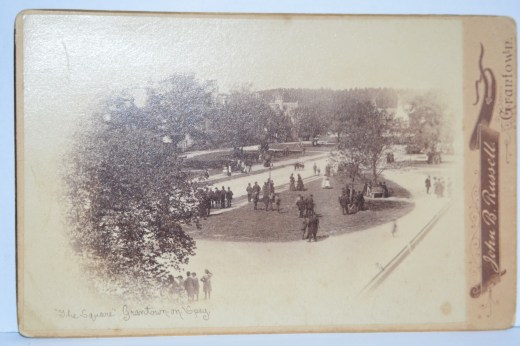
DSC_0751As well as taking photographs I also collect old pictures and postcards of the area. I recently purchased a late 19th century photo of the Square in Grantown a dozen or so miles to the north down the Spey. It was taken by the then local professional photographer, John B. Russell. most pictures of the square will have a few people dotted about, but this one has quite a high number of people in it. This raises the question of why they were there? They appear to be largely stationary at a time when exposure time was so slow that any movement rendered figures a blur. They seem to be waiting for something or somebody. Curiously most of them are looking away from the camera. To solve this riddle one needs additional information, especially if one is unfamiliar with the area and its history. One possible clue is that the road entering the square towards which most of them appear to be looking is called Castle Road. The castle in question being Castle Grant the residence of the chiefs of Clan Grant, the Earls of Seafield. The dress of the people suggests that they are well-to-do which in turn suggests that they are well-heeled summer visitors. Yet the random grouping would also seem to deny that anything formal was about to happen. I suppose you could try and explain it by proposing that the photographer had asked them to stand still and look down the road but that is highly unlikely given his lack of social status. Initially, I believed that the answer was that a member of the Seafield family, possibly the Countess was expected to pass by. But I made the mistake of showing the picture to a friend who pointed out a few things that I missed. Firstly, that the figures nearest the camera were boys wearing kilts. As the picture was taken from the Orphanage it begs the question if they were some of the orphans, even though they were apparently well-dressed for Victorian orphans. Secondly, they seems to be a body of people at the entrance of the square but they are very indistinct. My friend using a magnifying glass thought they were soldiers with kilts on. However, they are partially obscured by the leaves and branches as well as being affected by the slow speed of negatives in those days.

Equally when you look further back into history and read a passage from the Bible you can get a good picture of what happened yet at the same time there are often questions which arise. Some from the historical and cultural context which might have been lost. Though using the analogy of the picture referred to above a new believer who starts to read the Bible is like someone who knows nothing of Grantown looking at the picture sees its a picture of the Square but does not see its significance. We must also be wary of coming to a conclusion based on insufficient information. I had hoped that when I started this post I would have everything wrapped up neat and tidy but that is not the case. When studying Scripture the additional information required is often that of other parts of Scripture which shed light on the passage you are reading. But there are other sources such as commentaries, concordances, and Bible dictionaries which can help as well. Sadly these study aids are often disdained in Charismatic circles where the indwelling of the Holy Spirit is considered to have rendered them redundant.

But I realised that God was showing me another important point. It says in Proverbs that “Iron sharpens iron” and just as I found that my friend pointed out certain things to me in the photo, others will point out things we miss when we read the Bible. We may not entirely agree with what they say, but if it stops us from charging off in the wrong direction then interaction has served its purpose.

David Rose, 2016

Posted in Christianity, History, Uncategorized | Tagged , , , | Leave a comment

Why Do Birds Poop on Bird-feeders?

DSC_0684

How many pastors feel like this bird-feeder, pooped on by those they are trying to help?

As I have said in previous posts I have bird-feeders, but if one expects the birds to care where they leave their droppings, think again. You might think that a bird would respect the area where they got their food, but they don’t. Its the sort of thing that brought the phrase “bird-brain” into the English language. But some Christians are not much better when they speak negatively about those who feed them spiritually. Whether it is the church itself or its leadership. The difference is that they should have the intelligence to realise the damage they are causing. There must be many pastors who feel that they are like my bird-feeder at some stage in their career. It easy to criticise, and nobody is perfect, but there are occasions when it gets out of hand. This is at its most painful when it is those that the church or its pastor has gone furthest to help turns on them. Sometimes this might arise from an innocent misunderstanding, at other times it is deliberately malicious. Of course, the birds that poop on the feeder may not necessarily be the birds that are using the feeder itself, some are too big to use them. Likewise some criticism comes from without a congregation/fellowship. This might be expected from different ends of the spectrum of Christian traditions but sometimes the most vicious can come from closer to home. Some nuance of Biblical interpretation is often taken greater exception to than if a core doctrine is questioned. I know that in the past I have attended meetings with an imaginary tick-list looking for some fault or another for which I can mark them down. In this age of social media it is even easier to say something that should have been left unsaid. There was a report a year or two back from Police Scotland  that there had been a decline in reported physical acts of violence, but a corresponding increase in malicious comments online. Too many click the send button before they engage their brain. There is an acronym to discourage harmful statements:- T.H.I.N.K., which asks people to consider what they say before they blurt it out. T, is it True? H, is it Helpful? I, is it Inspiring? N, is it Necessary? And K, is it Kind? I have to admit that not everything that I have said in my life passes that test. Even so Job’s comforters probably would have argued that they were in line with the above acronym but the Lord rebuked them, Unfortunately it is a lot easier to clean the mess off my bird-feeder than restore the reputation of someone who has been falsely accused of something so be careful.


David Rose, 2016.

Posted in Christianity, reflections, Uncategorized | Tagged , , | Leave a comment