Is the Word ‘Pagan’ a Christian Swearword?

I ask this because the way some Christians use it you would think so. Every time they hear or see something they don’t like the word ‘pagan’ appears on their lips the way a four-letter word is used by the ungodly. As Christmas approaches how many times have we heard from out fellow Christians that Christmas is pagan, or at least that its origins are pagan. Well, the way the secular world around us celebrates it maybe, but as Christians, surely it cannot be wrong to celebrate the birth of the Saviour of the World? True, he was probably born earlier in the year about the Feast of Tabernacles. But he came to lighten up a dark world so that celebrating it at the end of December is not so bad an idea. How often have I heard from fellow believers “I do not celebrate Christmas.” Is it mandatory that Christians become party-poopers? I don’t think so. Yet all too often as Christians we think because we have turned our back on the world we have put on spiritual hair-shirts and seem to resent other people enjoying themselves. The fact is that when man turned away from worshipping the Creator they worshipped His creation instead. God meant us to look at His creation and be drawn to him. A symbol taken from the world, like a Christmas tree, might be used to symbolise the trinity because of its triangular shape, or one might equally prefer to see it as an object of some ancient pagan religion. If we choose only to see the pagan elements in Christian festivals are we not doing Satan’s work for him. It is alright for believers to enjoy themselves, it is just that we do not need to get drunk or overeat to do so.
David G. Rose.

Posted in reflections | Tagged | Leave a comment

Reflections on the Cross – Part 1 – The Lamb Slain Before the Foundation of the World.

Many years ago back in the 1970s I was watching the old Nationwide programme on the television and for some reason they had a rabbi on. He was asked why Jesus had said “My God, My God why have you forsaken me?” His answer was that Jesus was merely quoting Psalm 22. From a worldly point of this might appear to be correct. Though they was something that did not seem quite right to me with his explanation.

It ignores the spiritual dimension. Psalm 22 was written by King David. Yet there is no indication as to which point in his life. To Christians this is regarded as one of the Messianic psalms. In the first part of the psalm the author appears to be suffering the hallmarks of crucifixion “all my bones are out of joint” (v14); Dogs [foreigners] have surrounded me; a band of evil men have encircled me, they have pierced my hands and my feet. (v16); “They divide my garments among them and cast lots for my clothing.” (v18). But David did not suffer crucifixion but died in his bed at a grand old age. One could therefore argue that David had a vision of of Jesus being crucified. If so, then one could equally argue that David had quoted Jesus. Furthermore the book of Revelation refers to the “Lamb slain from the creation [foundation] of the world” 13.8, would support this view.

The psalm ends on a more positive note where the psalmist says “they will proclaim his righteousness to a people yet unborn – for he has done it,” (v31). The last part of which could be translated as “It is finished.”

The question arises as to which time in David’s life did he write this psalm? If one rephrases the question as to which time in his life did he need to have a vision  of the future Messiah  dying for his sin. If one thinks along those lines, then there is the possibility that it occurred in the aftermath of his affair with Bathsheba after it had been exposed by Nathan the prophet. True, that Psalm 51 is also attributed to this period with its “Create in me a clean heart. But could not Psalm 22 also be from that time? Why not?

About a year or so earlier than these events David had the idea of building the first temple in Jerusalem, but the Lord forbade him from doing so, leaving the honour to David’s son. But Nathan’s prophecy also referred to the future Messiah as being David’s son. David knew that his existing son’s were not good enough persons to be the Messiah. So, it is just possible that when David espied he was looking for a perfect woman to bear a perfect son. Tragedy followed when in order to cover up his infidelity he had Bathsheba’s husband, Uriah the Hittite, put to death. Nathan the same prophet that proclaimed that proclaimed that that his son would live forever, now proclaimed that Bathsheba’s son would die because of his sin. David prayed earnestly for the babe’s health to be restored, prostrating himself before the Lord for days without eating. When he was in this position he would have been in a similar position to a man being crucified, albeit in a horizontal rather than vertical one. After the child died David must have realised that the son who would reign forever would have to be another descendant. He hoped, no doubt, that it would be Solomon his next son borne by Bathsheba. He would build the Temple. In doing so, what was the will of the father was accomplished by the son. But Solomon turned away from the Lord in his later years, so any hope that he might have been  the Messiah was misplaced. A thousand years later another Son of David would pray “not My will but Yours” to His heavenly Father – The will of the Father was accomplished by the Son. He accomplished it by dying on the cross for the sins of the world. For those who died in the past like David and those who would live in future like you and me. It is possible that when Paul spoke about being crucified with Christ he was alluding to Psalm 22, in the David must have had vision of Jesus dying in his place. ;Likewise, we can say that we have been crucified with Christ – The Lamb Slain before the foundation of the world.

Posted in reflections, Uncategorized | Tagged , | Leave a comment

Lurcher’s Crag – An Illustration of Revelation.

ImageHave you ever wondered how some Christians wax lyrically about some verse of Scripture that means little or nothing to you? You think how on earth do they find so much in it? It is a question of revelation. As a secular analogy, many years ago I attended a talk about the origins of the Gaelic names of the hills and mountains seen from Aviemore including that of Lurcher’s Crag. it was stated that it was named so because it looked like a lurcher. As someone relatively new to the area I had not previously noted this, and I could see from the outline of the sketch of the Cairngorms used to illustrate the talk that I could vaguely see the likeness. Yet when I looked at the hills afterwards I could not see it for myself. Years went by until I attended another talk when someone showed a slide of Lurcher’s Crag and pointed out the salient features of the dog-like shape. Now, the next time I looked up at the hills I could really see the lurcher of Lurcher’s Crag. But it is still more obvious at certain times than at others.Image After all it is a natural feature and not Mount Rushmore. It depends in part in the position of the Sun. it also depends on where you are looking at it from. The  first photograph was taken too late in the day as the crags are no longer in shadow. But it is often most obvious after a heavy snowfall. Spiritually speaking, we cannot expect God to reveal things to us if we are in the wrong place. We have to be in His Word and subject to  His timing. Revelation, when it comes, is rarely as spectacular as in 2 Kings 6:17 when Elisha prayed that his servant’s eyes so that he could see the size of the angelic armies that protected them. It is likely to be a small gem here or a wee nugget there. If you could not see the lurcher in the first picture then look at the second picture with the darker patch silhouetted against the white snow, what appears to be the head, shoulders and rear leg can easily be made out. (Its forelegs can rarely be distinguished.) Now look back at the first and you should begin to see the pattern. Likewise when God reveals something to us we look back and begin to see the pattern in Scripture or in our lives. If I had continued to look for the lurcher after  I had first been informed of it, then I might have seen it a lot sooner. Sometimes we need to seek revelation on a certain matter before God will reveal it to us. He wants a hunger in or hearts. He wants us to have more than a passing academic interest in a matter. He wants to know that we are serious. He does not want a Laodicean tepidness.

David G. Rose, 2012.

Posted in reflections | Tagged , | Leave a comment

When a Hedge Grows Wild.

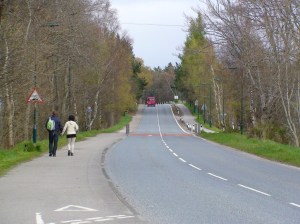
Image                    Have you noticed the old parish church of Rothiemurchus whilst travelling along the B970 near the Doune? Unless you knew it was there you would miss it because the hedge that surrounded it was used as a church has grown up and hidden it. Likewise, it is right and proper for churches to have rules so that the sacred and the profane can be separated like a hedge planted round a church. When first planted a hedge is short and narrow. However, if they are not kept trimmed, as they grow they begin to obscure what lies behind them. That can be a problem with the rules of churches and other Christian organisations, as over the years they become traditions which though planted in biblical principles can grow out of proportion. To those on the outside all they see is a series of “thou shalt nots” with the reasons for them forgotten. They only see the rules and not Christ. Rather than being drawn to Christ they see a sign saying “you’re not welcome here because you are not good enough.” To those on the inside the rules become a shelter that they can hide behind. When other Christians try and prune them and cut them down to size they are often accused of compromise. Here there is often a confusion between doctrine, what we believe, and practice, how we apply those beliefs when we put them in both a church and everyday life. It is, of course, right to expect a person’s practices to reflect their beliefs. It is all too easy to inflate some practice or another into something  of greater importance as if it were a fundamental of the faith. But surely only doctrines can be described as fundamental and not practices. There is a saying in Scotland:- “Here’s to us, wha’s like us. Gey few and maist of them are deid.” Too many Christians seem to think there are the last of the true believers, because they are the only ones upholding some aspect of Christianity or another. Often judging other Christians solely on one particular aspect, in cases like this they what should be a shrub has become a veritable leylandii towering above everything else. In extreme cases the example of 2 Kings 18:4 may have to be resorted to where it is stated that King Hezekiah destroyed the bronze serpent that Moses had made because the people were offering incense to it.

David G. Rose, 2012.

Posted in Uncategorized | Tagged | Leave a comment

Yesterday, Today and Forever

ImageHere are three photographs taken from roughly the same place at the south end of Dalnabay and before one comes to the engine shed. I have noticed over the years that Cairngorm rarely looks the same twice. Its appearance changes from season to season, and from one type of weather to another. Lighting conditions can change from moment. Question: Does Cairngorm change with its appearance? Apart from a little erosion here and there, Cairngorm stays the same year in and year out.Image Even when it is shrouded in cloud and mist it remains the same. When we ask the question – does God change? The answer is more emphatically that he does not. The Bible says of God the Son “Jesus Christ is the same yesterday, today and forever,” Hebrews:13:8. The same can also be said of the other members of the Godhead. But our perception of God changes as we go through spiritual seasons.Image Our emotions can cloud over in an instant, and suddenly our warm and sunny view of God changes to one that is cold and distant. We can even think that if we cannot see God, or feel if he is not there, then he cannot be there. Yet that is as stupid as saying that Cairngorm is not there because it is covered in cloud, rain or snow. We all have our ups and downs in life and it is all too easy to have the spiritual equivalent of Seasonal Affected Disorder Syndrome and spiritually hibernate. Whether the changes that occur in our perceptions come from natural or supernatural quarters, when the spiritual storms of life blow in we tend to blame God for them. In the longer term these seasons, in fact, when looking back be stages of our spiritual growth and maturity.

David G. Rose, 2012.

Posted in Uncategorized | Tagged | 1 Comment

The Dragonfly – Lessons from Metamorphosis.

SONY DSCThis photograph was taken at the Lily Loch and depicts a female drsgonfly in the act of laying eggs. I had noted it bobbing up and down over the same spot. Dragonflies are among those insects that lay their eggs in water. Thus their larval stage hatch and grow underwater, when they have grown to a certain size the larva will climb a red and emerge from the water and pupates. The larva effectively turns itself into a soup and reforms itself as an adult dragonfly. This type of life cycle speaks of a designer who has preprogrammed these phases into their DNA. How could such changes evolve through random chance? It is far too complicated. The second point is that the dragonfly cannot return to the medium in which it hatched without it being trapped by the surface tension of the water. The consequences would be fatal. Here is an analogy of the born-again believer who becomes a new person in Christ Jesus. As it says in Romans 12:2a “Do not conform and longer to the pattern of this world, but be transformed by the renewing of your mind.” Yet equally it has to complete its life-cycle by laying its eggs in the very water that could kill it. Likewise mature Christians have to break out of the “Holy huddle” mentality to plant the seed of the Gospel in the world they have come out of. It is just a question of balance.
David G. Rose 2012.

Posted in reflections | Tagged | 2 Comments

The Two Brummies or Where is the Car Park?

DSC03730Early one morning back in 2002 I was cycling to work. As I passing the fish-farm in Rothiemurchus I noticed a pick-up truck parked beside the road. The occupants of which flagged me down as I passed them. They had equipment they had to deliver to the funicular railway which was under construction at the time. As soon as they spoke I could tell that they were from the Birmingham area. I explained that they were on the right and should carry on. But that did not satisfy them, they had convinced themselves that something had been missing from the instructions they had been given. I could tell that they were unfamiliar with the area and were used to a far more complicated road system in the west Midlands than exists in the Highlands. So eventually I had to tell them that the road they were on, but it was the best part of ten miles away and 2000 foot above sea level. At which point jaws dropped in unison. Finally they had got the message and I could get on my way and not be late for work. On reflection of this I felt the Lord telling me that I was just like those two Brummies with God being frustrated with me, as I was with them, refusing to keep on keeping on. When we get out of our comfort zone we are like Peter when he got out of the boat to walk on the water. he ewalked sufficiently far from the boat and the other disciples that when he got into difficulties that going back was no longer an option. It says in Matthew Ch14:v31, “Immediately Jesus reached out his hand and caught him,” so Jesus was within reach of Peter when he began to panic. Sometimes it is when we are almost there that the fears flood in. We have to resist the temptation to return the way we came with our good undelivered, but instead persevere to the end.
David G. Rose, 2012.

Posted in reflections | Tagged | Leave a comment

The Maker’s Manual.

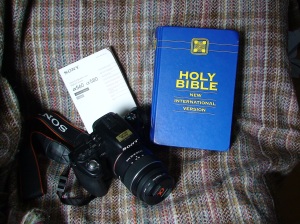
DSC03727Some months ago I found that my camera was taking three pictures at a time, albeit at different settings. As I was still unfamiliar with many of the camera’s functions I looked at the manual but could not make sense of what I had done. I hoped that it would rectify it. It did not. Taking it back to the shop would entail a journey up to Inverness, expense and potential embarassment if I found out That I had done something stupid. Because it was something that I could live with I delayed going in. But as the camera takes 16meg pictures and as 3×16=48meg I was using up the memory card at a rather quick, so after a fortnight I called in. I explained the situation to the young female assistant. She took the camera knew enough to know what the problem was but because she was not familiar with that model, when she started to play around with the various buttons on the camera at the speed of an expert texter, she was unable to find the function. I commented that there were a lot of buttons on cameras these days. She agreed but I suspect did not appreciate the comment. At that point I brought out the manual. Within seconds she found the correct page and the correct button and was able to rectify it almost instantly. How often do we not treat God’s manual for us the Bible, ina similar manner? I did look at the camera’s manual but did not understand it. I should have taken more time to study it. Likewise, we need to take time to study and gain understanding of Scripture as Paul wrote to Timothy, “All Scripture is God-breathed and is useful for teaching, rebuking, correcting and training in righteousness, so that the man of God may be thoroughly equipped for every good work.” 2 Timothy 3:vv6-7.
David G. Rose 2012

Posted in reflections | Leave a comment

Do you consider this flower beautiful? Yes?

SONY DSCThis photograph was taken on a piece opposite a call centre that most people would not look twice at. Having recently bought a new camera I thought that I might try out the telephoto lens by taking close-ups of wild flowers. I spotted some dog roses among the unsightly scrub. Whilst taking these pictures a woman walked past, her head looking down and avoiding eye contact, listening, I think to her I-pod. She apparently did not see anything of beauty to fix her gaze upon. Afterwards I considered how sometimes are lives seem like a patch of wasteground, spolied, covered in weeds, we disregard ourselves and disregarded by others and become very negative. but when we are at our lowest  God can zoom in  focus on something beautiful. As if to say, ‘I know you are a sinner and the world you live in is a chaotic mess, but amongst all this there is this positive thing, concentrate on this.’ Just like Jeremiah who in the midst of his Lamentations could say “for his compassions never fail. They are new every morning; great is Your faithfulness.” Lam. 3:22b-23.

David G. Rose, Aviemore, 2011.

Posted in Uncategorized | 1 Comment